


Evacuations from High-Risk Locations Call +44 (0)1202 308810 or Contact Us →

Immediate Response

Emergency Evacuation
from the Middle East

Emergency Evacuation from Middle East Solace Global

Iranian retaliation following joint US and Israeli airstrikes inside Iran has involved sustained ballistic missile, cruise missile, and one-way attack unmanned aerial vehicle (OWA-UAV) strikes across the Middle East since 28 February 2026.

Attacks on US military and diplomatic missions have been observed in Iraq, Kuwait, Bahrain, Qatar, the UAE, Saudi Arabia, and Jordan. The dual-purpose civilian and military port of Duqm in Oman has also been repeatedly hit by UAVs.

Whether you are based in Israel, the United Arab Emirates (UAE), Saudi Arabia, Qatar, Oman, Kuwait, Bahrain or Jordan, our evacuation services provide clear, discreet and well-managed departure support.

Middle East Conflict: Latest Intelligence & Travel Advice

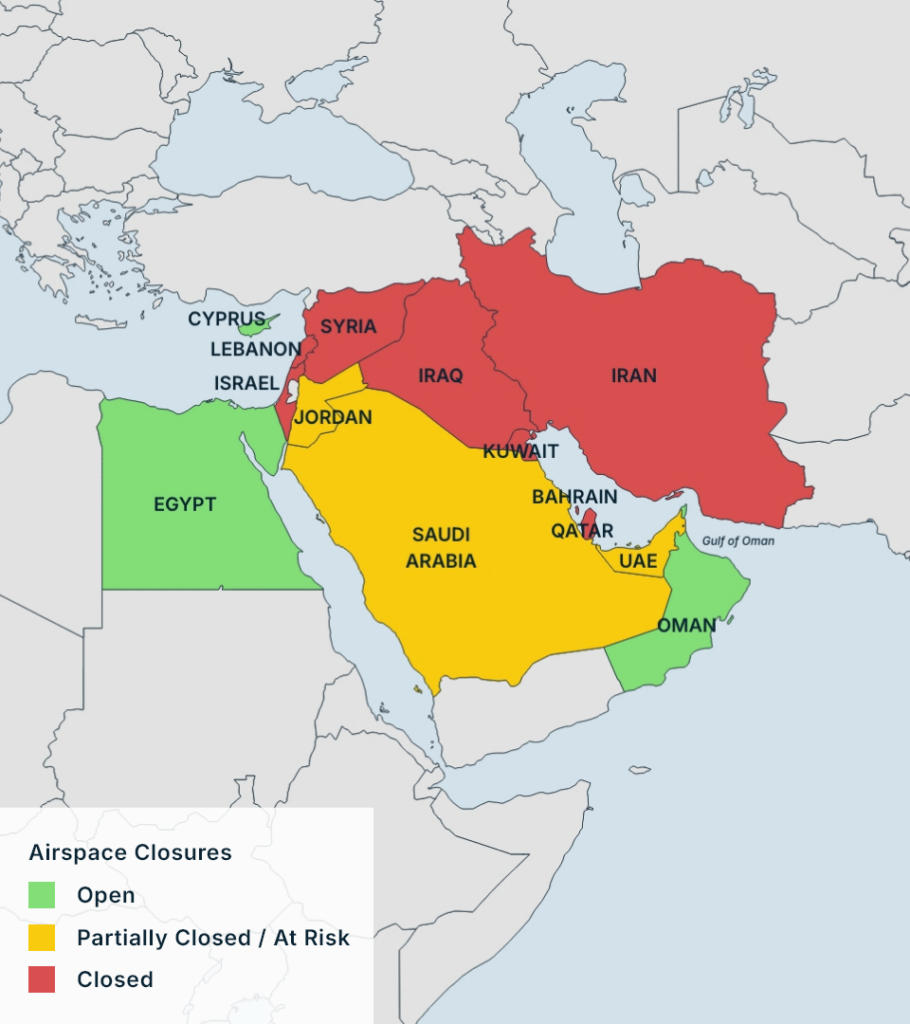
To support planning, we are updating our Middle East travel advice daily with guidance from our intelligence team on airspace openings and closures, flight operations, and escalating risks impacting movement.

Which Airports in the Middle East are Currently Open?

Due to the evolving security situation across the region, airport operations and Middle East airspace access remain highly volatile. Governments may impose airspace closures, flight suspensions, or airport operating restrictions with little or no notice, meaning flight availability can change rapidly.

Based on the latest operational assessments, several airports in the region continue to support limited commercial flights, charter operations, and contingency evacuation movements.

However, travellers should be aware that Middle East airport status can change quickly due to military activity, airspace closures, aviation safety measures, or government directives. Public flight schedules may not accurately reflect real-time operational conditions.

Intelligence cut off date 04 March 2026 08:47 UTC

Specialist Private Security Across the Middle East 

How our Emergency Evacuation Process Works 

Security Monitoring & Exit Feasibility

Our 24/7 Global Security Operations Centre (GSOC) tracks developments across Israel, Dubai, Abu Dhabi, Riyadh, Jeddah, Doha, Muscat, Kuwait City and Manama, including:

  • Airport operations in Dubai, Abu Dhabi, Doha, Riyadh and Tel Aviv
  • Commercial flight availability and route changes
  • Airspace restrictions and rerouting
  • Border status and regional transport disruption

Before movement begins, we confirm what is operational and identify the most reliable departure route available at that time.

Personalised Evacuation Planning

Every evacuation plan is tailored to the individual or group involved. We assess:

  • Your exact location within Israel or the Gulf state
  • Nearest operational airport or secure land corridor
  • Availability of commercial flights
  • Charter flight feasibility from UAE, Qatar, or Saudi Arabia
  • Cross-border evacuation routes by land
Luxury Vehicles and Private Aviation IconSecure Transport & Assisted Departure

When activation is required, we coordinate secure ground transport and managed departure.

Support may include:

  • Low-profile or security-trained drivers in Dubai, Abu Dhabi, Riyadh, Doha and Tel Aviv
  • Armoured vehicle options where threat levels warrant additional protection
  • Airport facilitation and real-time monitoring of departure terminals
  • Managed cross-border transport
  • Charter evacuation flights from the UAE, Qatar or Saudi Arabia
  • Protective security personnel for higher-risk movements

All routes are reassessed in real time, particularly in areas experiencing heightened tension or transport disruption.

24/7 Security Assistance for Middle East Evacuations

Every evacuation across the Middle East is supported by continuous oversight from our Global Security Operations Centre (GSOC).

Operating around the clock, our team monitors developments across Israel and the Gulf states, including airspace status, airport operations, border crossings and wider security conditions. This enables us to adjust routes, departure timings and transport arrangements as circumstances evolve.

During active evacuations, GSOC maintains direct coordination with drivers, aviation partners and on-the-ground personnel, providing real-time updates and structured decision support throughout the movement process. From transport disruption to sudden airspace restrictions, oversight remains constant until safe arrival is confirmed.


Do I need a visa before crossing a land border?

Yes. Before travelling to any border crossing, you should confirm the visa requirements for the country you intend to enter, based on your nationality and residency status.

Some travellers may qualify for visa-on-arrival or eVisa, while others must obtain a visa in advance. Entry requirements can change quickly during periods of instability, so the most reliable information should always be obtained through official government immigration or consular websites.

Should I check my eVisa or entry permit expiry date?

Yes. Many travellers are turned back at borders due to expired or invalid visas.

Before departing for a border crossing you should confirm:

  • Your visa or eVisa is still valid

  • The visa allows entry through land borders (some only allow airport entry)

  • Your passport meets validity requirements (often 6 months remaining)

If your visa will expire during transit or shortly after arrival, you should arrange a new visa before departing.

What documents should I carry when evacuating across a border?

Travellers should carry both physical and digital copies of key travel documents.

Essential documents include:

  • Passport (ensure validity requirements are met)

  • Residence permit or national ID (if applicable)

  • Visa approval printout (if travelling with an eVisa)

  • Accommodation details on arrival

  • Evidence of onward or return travel

Should I arrange accommodation before crossing the border?

Yes. Travellers should secure accommodation or a confirmed address in the destination country before travelling.

Border officials may ask for proof of accommodation or onward travel, particularly when large numbers of foreign nationals are attempting to leave a country during a crisis.

Having accommodation arranged also provides a fallback location if flights or onward travel are delayed.

Are border crossings guaranteed to remain open?

No. Border crossings may:

  • Operate at reduced capacity

  • Experience significant delays

  • Close with little notice during periods of escalation

Travellers should expect long processing times and unpredictable operating hours during crisis situations.

Can Solace Global assist with evacuation planning?

Yes. Solace Global Risk provides 24/7 security assistance, evacuation planning, secure transportation, and crisis coordination through our Global Security Operations Centre and network of global security teams. We assess the situation and plan the safest available route to move you and your people to safety, arranging secure ground transportation from your residence or hotel to a border crossing or evacuation point, with support for onward travel where required.

Which Middle Eastern countries do you provide evacuation support in?

We coordinate emergency evacuation and secure transportation across Israel, the United Arab Emirates (UAE), Saudi Arabia, Qatar, Oman, Kuwait, Bahrain and Jordan. Support may include movement to operational airports, cross-border relocation or onward international travel.

What types of evacuation do you provide?

Support may include secure ground transport, airport facilitation, commercial flight coordination, charter flight arrangements and cross-border evacuation where required. The appropriate solution depends on current security conditions and available routes.

How quickly can evacuation be arranged in Israel or the Gulf states?

Timelines depend on airspace access, airport operations, border status and local security conditions. Our team assesses available options immediately and outlines practical next steps without delay.

What happens if airspace is closed?

If commercial flights are suspended, we review alternative airports, charter options and approved land corridors, including cross-border routes. All options are assessed against current entry and exit requirements.