Evacuations from High-Risk Locations Call +44 (0)1202 308810 or Contact Us →

Middle East Conflict: Latest Intelligence and Travel Advice

blue background

This page provides situational awareness and practical guidance for organisations and individuals with personnel in the Middle East following the recent escalation of conflict involving Israel, the United States, and Iran.

The security environment remains highly volatile, with ongoing military activity, airspace closures, travel disruptions, and government advisories likely to change at short notice.

This information is provided for general awareness only and does not constitute operational, legal, or travel advice. Decisions regarding shelter-in-place or evacuation should be made following a tailored risk assessment specific to your personnel, location, and circumstances. You should not rely solely on this guidance without first consulting Solace Global Risk or other qualified professionals, as conditions on the ground may change rapidly and options for movement may be limited or unavailable.

Solace Global Risk is actively supporting clients in the region, including the coordination of secure movements and evacuations from the Middle East. Speak to our security operations team 24/7 to learn more.

Outlook: Gulf Security Under Pressure From Iranian Attacks

Intelligence

Iran’s shift to the targeting of critical infrastructure and other civilian profile targets is likely reflective of an attempt to increase economic disruption across the Gulf, pressure regional governments that host US military bases and support operations, and demonstrate Iran’s capacity to impose widespread costs across the region despite being under sustained pressure from US and Israeli joint strikes. Iran may have also calculated that attacks of this magnitude may undermine the long-term presence of the US military in the Middle East by increasing the political and security costs for host nations and raising domestic pressure within Gulf states to distance themselves from US military operations.

Iran is also likely attempting to pressure Washington and Tel Aviv by provoking international condemnation and economic pressures on a global scale. Attacks on oil and gas infrastructure, followed by the suspension of operations at these sites, combined with a de facto Iranian blockade in the Strait of Hormuz, will almost certainly trigger economic shocks and volatility in global energy markets, as well as disruptions to maritime trade and energy supply chains. This strategy is likely to increase international pressure and could help to isolate Washington.

Continue Reading →

Outlook: Escalation Risks Persist After US–Israel Strikes on Iran

Intelligence

Current US and Israeli military operations mark a significant escalation from Operation Midnight Hammer, which involved preliminary strikes on Iranian conventional military capabilities to enable a US bombing run on Iran’s nuclear facilities. Furthermore, the scale of the US’s current force posture and forward positioning of military assets is the largest buildup in the region since the 2003 invasion of Iraq.

Iran’s current strategy is likely aimed not only at striking Israel and US military forces but also at generating widespread economic disruption, undermining US regional security guarantees and restoring deterrence by positioning itself as a resilient power capable of inflicting widespread damage and costs despite suffering major losses, evidenced by its attacks on Arab nations and attempts to blockade the Strait of Hormuz.

Continue Reading →

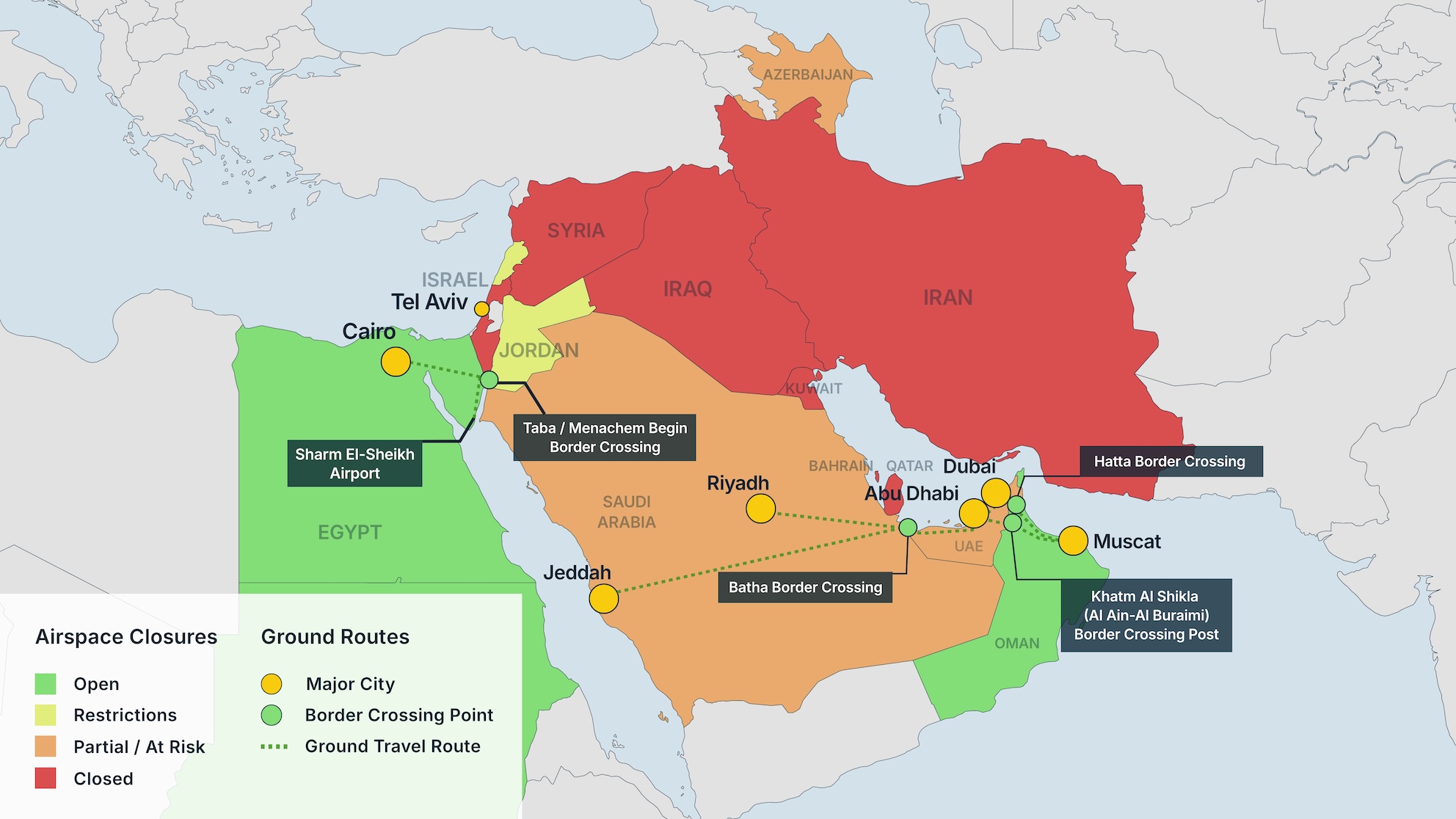
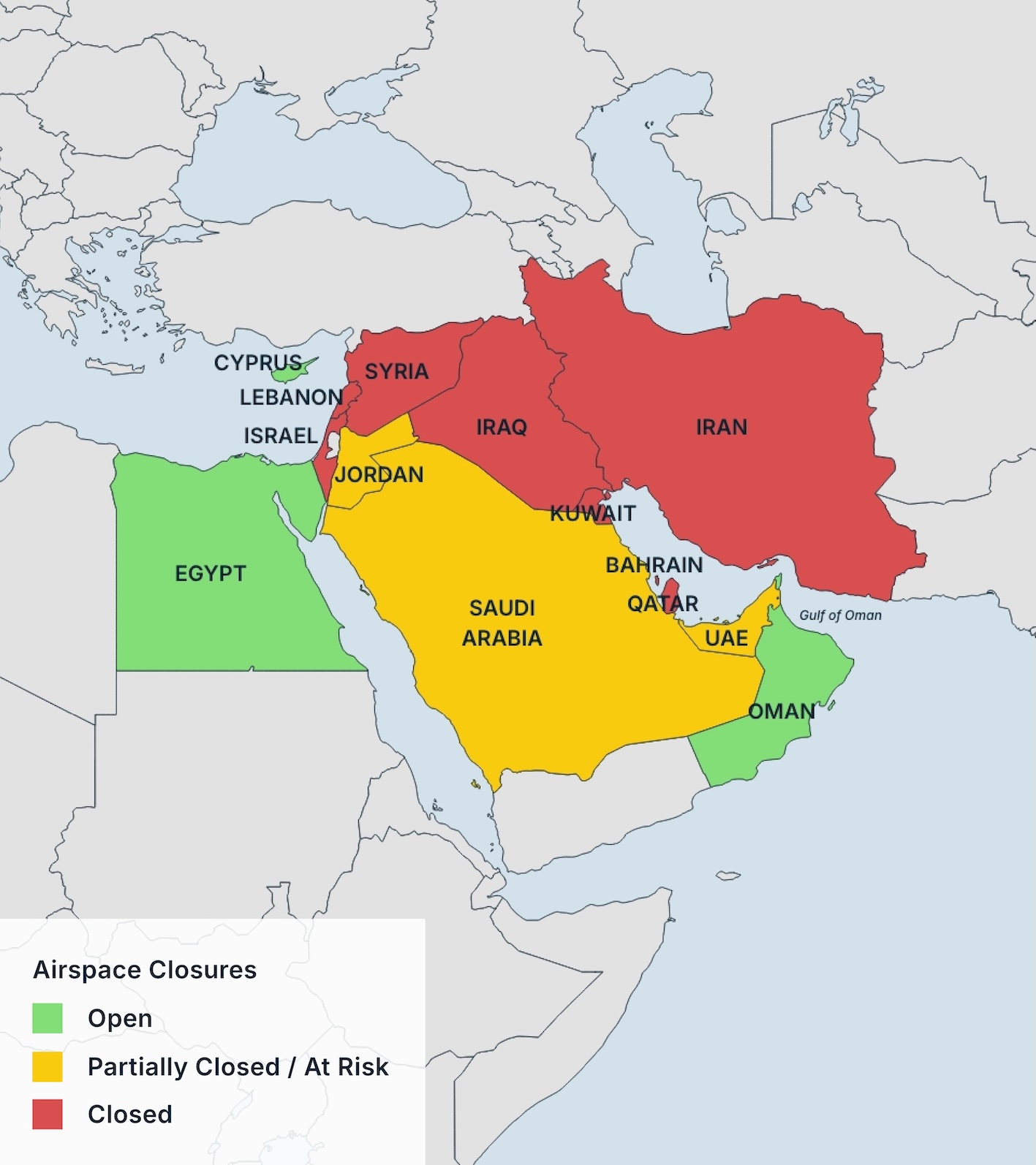
Latest Update: Airspace & Ground Routes – Israel and Gulf States

Operations

Intelligence cut off: 09:00 UTC 06 MARCH 2026

Oman’s airspace remains open, with Muscat increasingly used by regional airlines as a hub for relief flights, including services operated by Qatar Airways.

Israel’s airspace continues to be closed to most civilian traffic. Access is currently limited to military operations and civilian flights that have received prior authorisation.

Jordan’s airspace remains open; however, operators are being advised to plan for potential delays and carry additional fuel as a precaution.

  • Saudi Arabia: Partial closure affecting area bordering Iraq and the Persian Gulf  – Expires 2200 UTC | 5 March
  • Iran: Total closure – Expires 0830 UTC | 7 March
  • Iraq: Total closure – Expires 0900 UTC | 7 March
  • Qatar: Total closure – Expires 1600 UTC | 5 March
  • Bahrain: Total closure – Expires 1600 UTC | 5 March
  • Kuwait: Total closure – Expires 1600 UTC | 5March
  • Syria: Total closure – Expires 2100 UTC | 7 March
  • United Arab Emirates: Closure by way of Emergency Security Control of Air Traffic (ESCAT) zones – All expire 1200 UTC | 6 March
  • Israel: Total closure – Expires 1000 UTC | 9 March
  • Azerbaijan: Southern sector closed – Expires 1939 UTC | 5 March

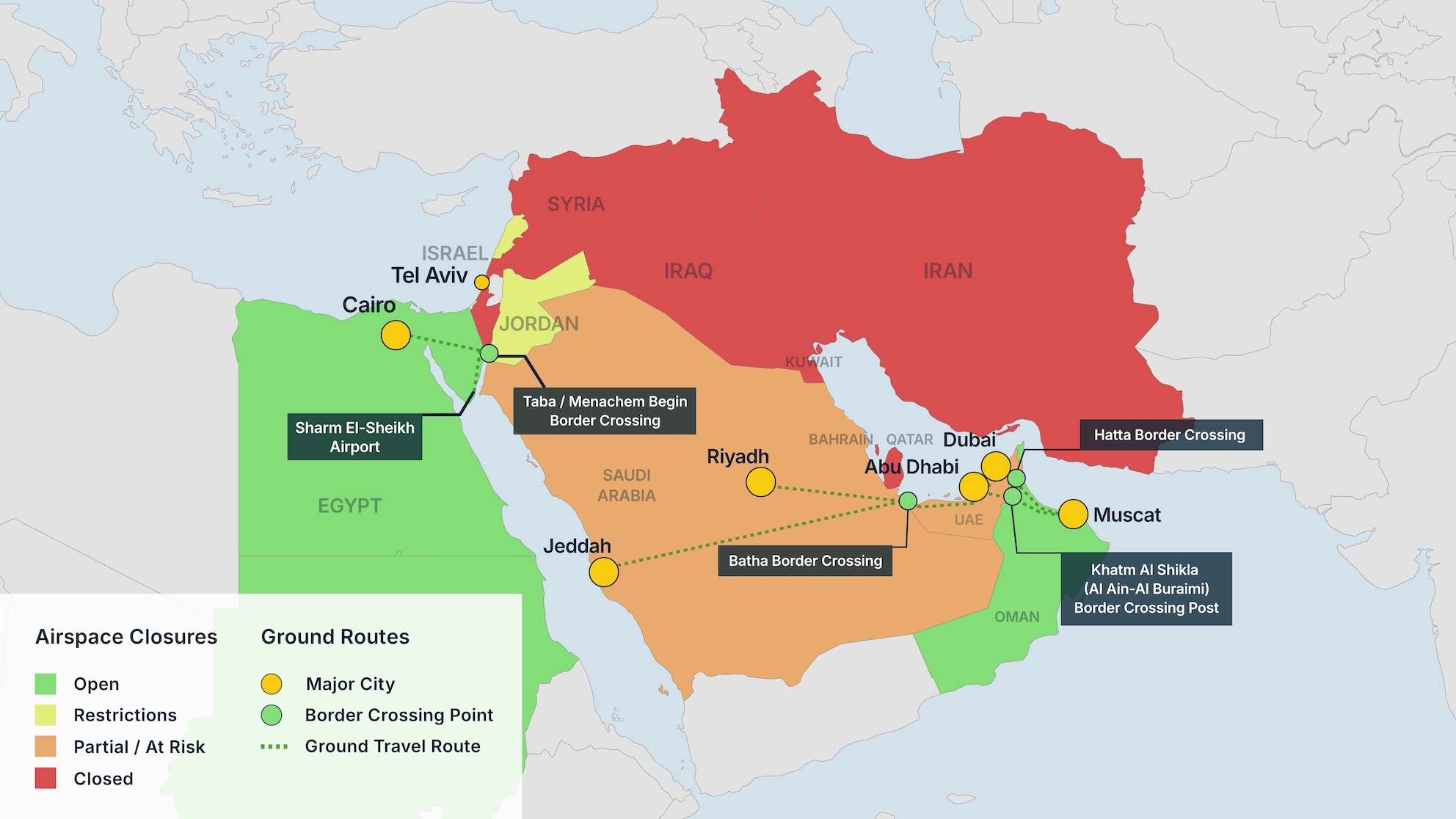
Latest Update: Airspace & Ground Routes – Israel and Gulf States

Operations

Intelligence cut off: 09:00 UTC 05 MARCH 2026

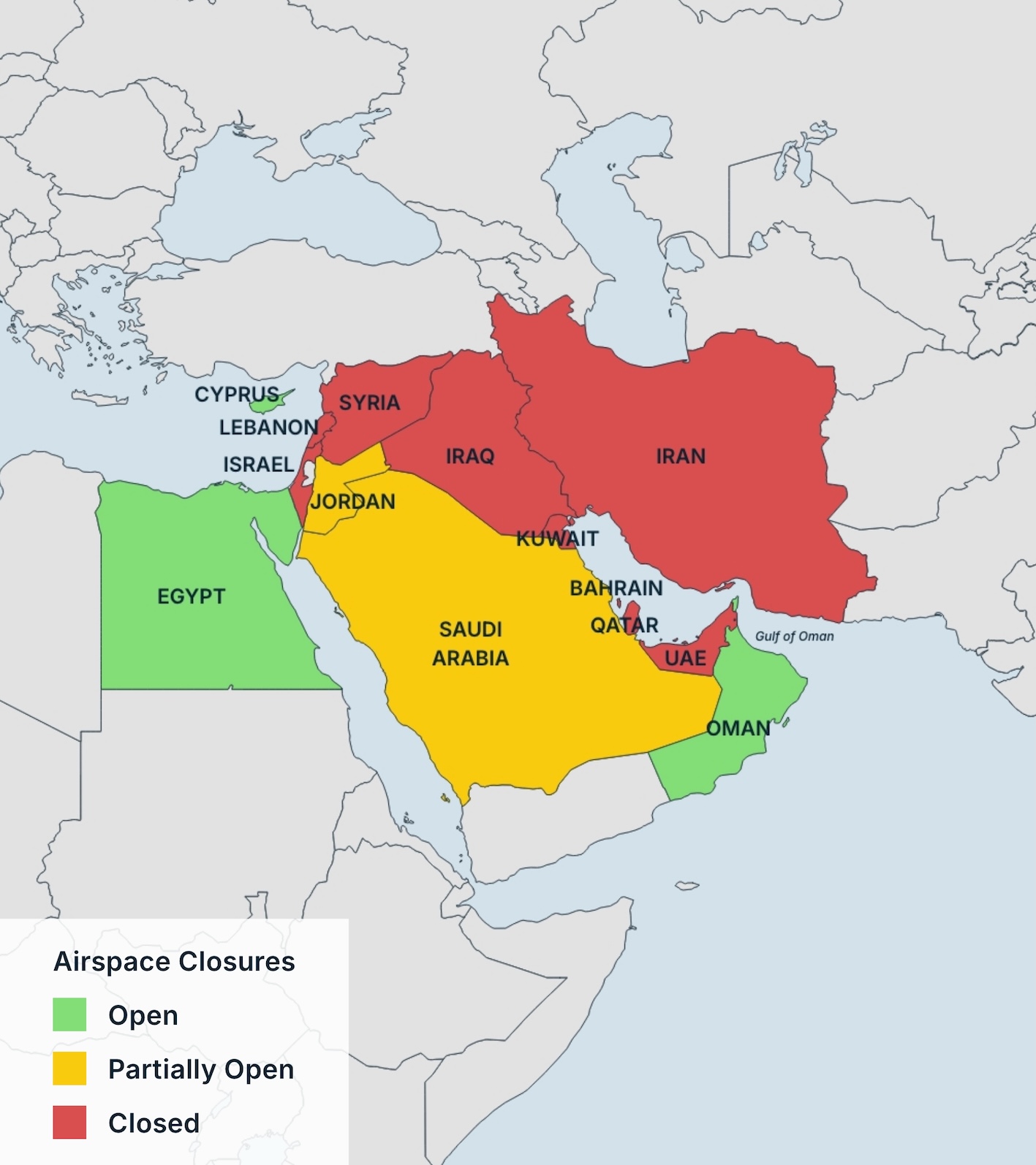
Latest Update: Gulf Airspace Closures Amid Iranian Strikes

Operations

Intelligence cut off: 08:47 UTC 04 MARCH 2026

We note that Oman airspace remains open. In addition, Jordan has removed its nighttime ban.

  • Saudi Arabia: Partial closure affecting area bordering Iraq and the Persian Gulf  – Expires 2200 UTC | 4 March
  • Iran: Total closure – Expires 0830 UTC | 7 March
  • Iraq: Total closure – Expires 0900 UTC | 7 March
  • Qatar: Total closure – Expires 1600 UTC | 4 March
  • Bahrain: Total closure – Expires 1600 UTC | 4 March
  • Kuwait: Total closure – Expires 1600 UTC | 4 March
  • Syria: Total closure – Expires 2100 UTC | 7 March
  • United Arab Emirates: Partially closed – Expires 1200 UTC | 4 March
  • Israel: Total closure – Expires 1000 UTC | 9 March

Solace Global is currently able to evacuate personnel from Dubai, Abu Dhabi and Israel. If you require assistance, our security team is available 24/7 to discuss secure transportation.

Contact us →

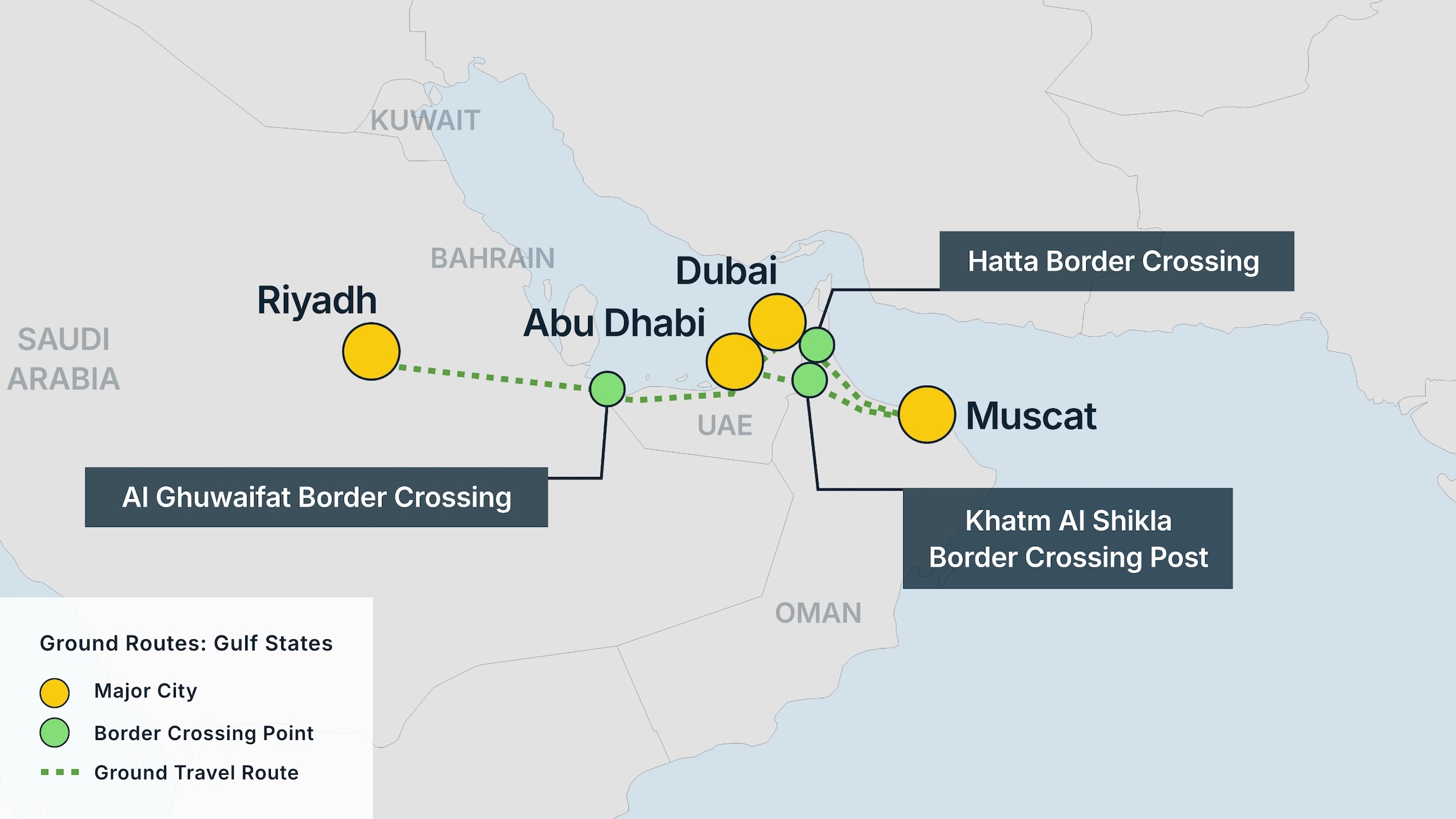
Latest Update: Ground Routes & Border Crossings

Operations

Intelligence cut off: 09:00 UTC 03 MARCH 2026

Gulf States Ground Evacuation Routes and Border Crossings Map

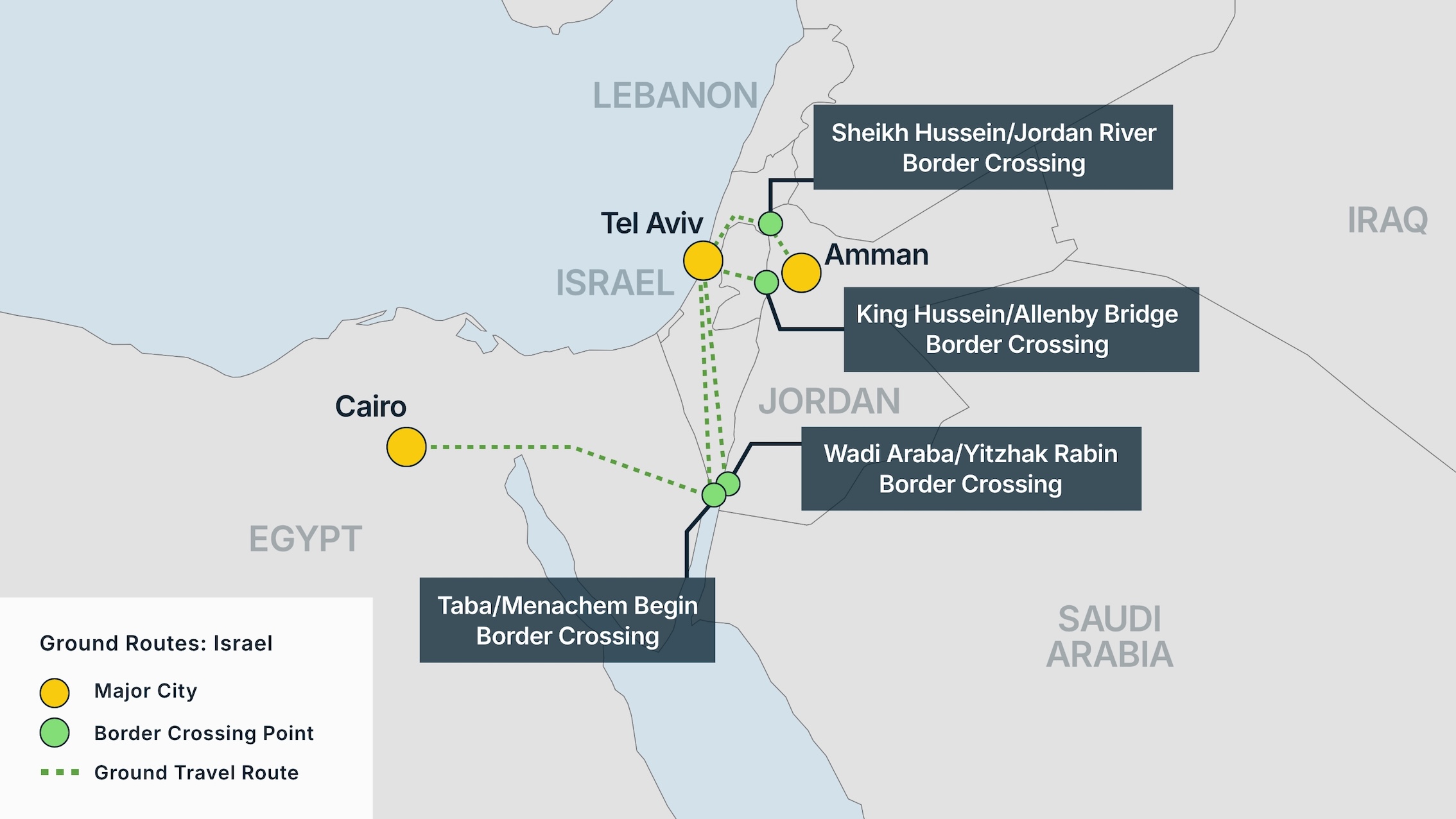
Israel Ground Evacuation Routes and Border Crossings Map

Please Note:

All ground movements are subject to current immigration and border regulations. Travellers must confirm entry requirements in advance, including visa eligibility, residency status, and passport validity. Border policies and processing times may change with little notice.

Evacuations conducted by Solace Global are assessed case by case, based on the evacuee’s citizenship and the entry requirements of the receiving country. Route selection depends on border accessibility, security conditions, and onward travel options.

Gulf Airspace Closures Amid Iranian Strikes

Operations

Intelligence cut off: 09:00 UTC 03 MARCH 2026

We note that Oman (OOMM) airspace remains open.

  • Saudi Arabia (OEJD) — Partial closure affecting area bordering Iraq and the Persian Gulf  — Expires 2200 UTC | 3 March
  • Iran (OIIX) — Total closure — Expires 0830 UTC | 7 March
  • Iraq (ORBB) — Total closure — Expires 0900 UTC | 4 March
  • Qatar (OTDF) — Total closure — Expires 1000 UTC | 3 March
  • Bahrain (OBBB) — Total closure — Expires 1000 UTC | 3 March
  • Kuwait (OKAC) — Total closure — Expires 1000 UTC | 3 March
  • Syria (OSTT) — Total closure — Expires 2100 UTC | 3 March
  • United Arab Emirates (OMAE) — Partially closed — Expires 1200 UTC | 4 March
  • Israel (LLLL) — Total closure — Expires 1000 UTC | 6 March
  • Jordan (OJAC) — Closed daily from 1500 to 0600 — Expires 0600 UTC | 5 March

Solace Global is currently able to evacuate personnel from Dubai, Abu Dhabi and Israel. If you require assistance, our security team is available 24/7 to discuss secure transportation.

Contact us →

Gulf Airspace Closures Amid Iranian Strikes

Operations

Intelligence cut off: 16:30 UTC 02 MARCH 2026

  • Since 28 February, Iran has conducted ballistic missile and attack drone strikes against targets in Kuwait, Qatar, the United Arab Emirates (UAE), and Bahrain in response to joint US and Israeli airstrikes inside Iran.
  • Iran has further escalated strikes against civilian-profile targets and economic interests, including oil and gas infrastructure, in addition to strikes targeting US military facilities.
  • Airspaces remain closed across Kuwait, Bahrain, Qatar, and the UAE, as of 2 March.
  • In Kuwait, the Doha West power station, Mina Al Ahmadi Refinery, and US Embassy in Kuwait City were impacted. Most drones were reportedly intercepted near Rumaithiya and ⁠Salwa neighbourhoods.
  • In Bahrain, a foreign vessel in Salman Industrial City and a US-flagged tanker in the Port of Bahrain were impacted. Bahrain International Airport (BAH / OBBI) was targeted on 1 March by an Iranian drone, causing material damage but no casualties.
  • In Qatar, air defences intercepted attacks reportedly aimed at civilian infrastructure, including Hamad International Airport (DOH / OTHH). A water tank in Ras Laffan Industrial City was also impacted.
  • The UAE has been the second most targeted country behind Israel. Further explosions were reported in both Abu Dhabi and Dubai on 2 March.
  • Further Iranian strikes remain highly likely in the near term, and while likely continuing to prioritise the targeting of US military installations, they will also likely continue against civilian-profile targets due to the escalation in Iranian targeting patterns.
  • The UK FCDO maintains its travel advice to advise against all but essential travel to Kuwait, Bahrain, Qatar, and the UAE.

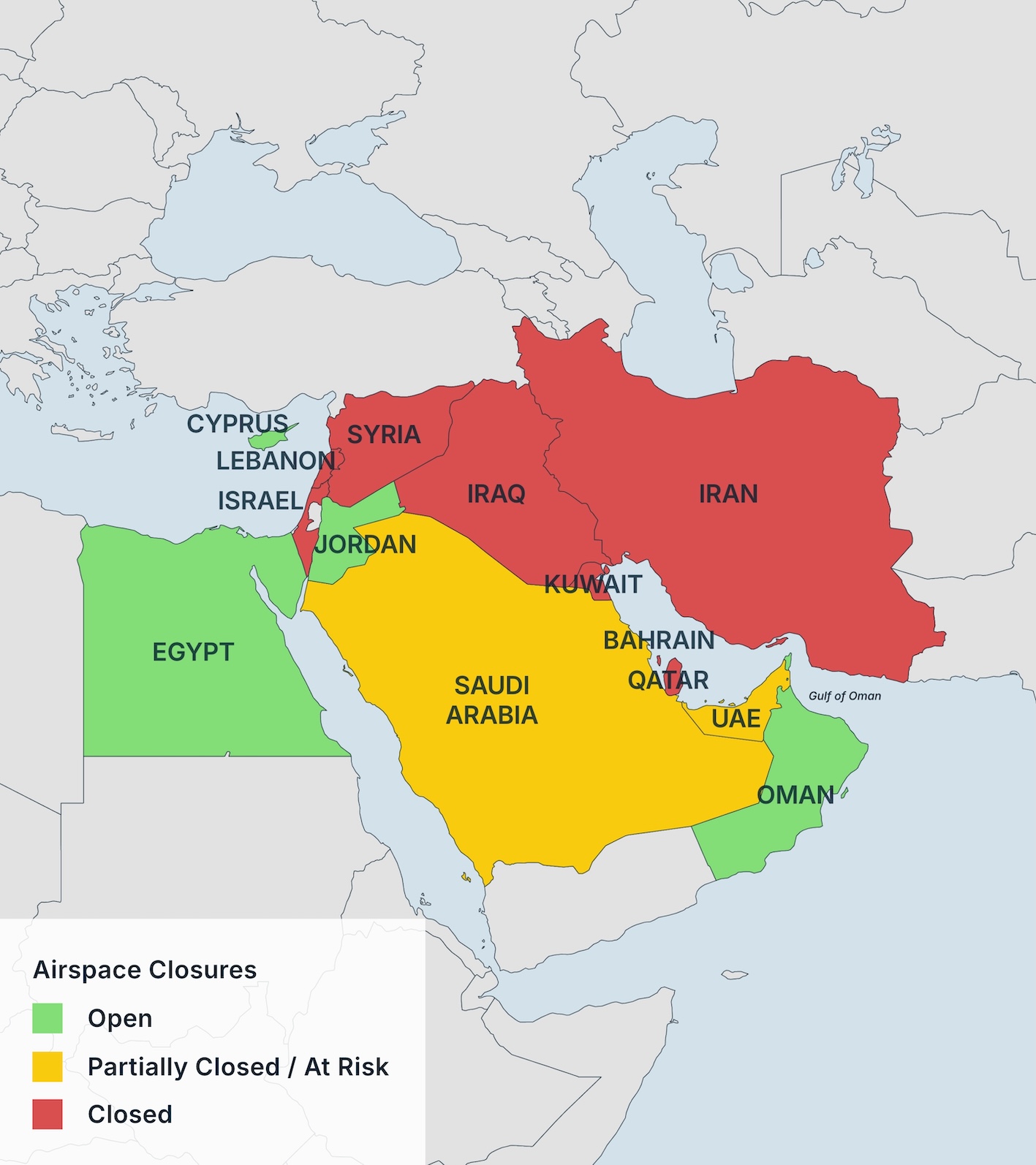
Airspace Closures across the Middle East

Operations

Intelligence cut off: 11:00 UTC 02 MARCH 2026

Latest Updates: Airspce Closures across the Middle East
  • Cyprus: Airspace Open
  • Egypt: Airspace open. Israeli passport holders NOT permitted entry.
  • Jordan: Partial closure on a daily basis, between UTC 1500 and 0600, until March 5th. Israeli passport holders must use this route, open to all other passport holders.
  • Saudi Arabia: Partial closure affecting area bordering Iraq and the Persian Gulf
  • Bahrain: Total closure
  • Israel: Total closure
  • Iran: Total closure
  • Iraq: Total closure
  • Kuwait: Total closure
  • Qatar: Total closure
  • Syria: Total closure
  • United Arab Emirates: The United Arab Emirates (OMAE) airspace is not outright closed, but remains restricted by way of Emergency Security Control of Air Traffic (ESCAT) zones, effectively limiting commercial air traffic.

Travel Advice for the Middle East

Travel Advice

Intelligence cut off: 12:30 UTC 28 FEBRUARY 2026

  • Avoid all non-essential travel to the Middle East.
  • Travellers should follow shelter-in-place orders and advisories, particularly in Iran, Israel, Lebanon, Qatar, Bahrain, Kuwait, the United Arab Emirates, Saudi Arabia, and Jordan.
  • Do not conduct travel to the airport until shelter-in-place orders or recommendations are lifted. Once lifted, ensure that booked flights are still running before conducting travel to the airport.
  • Ensure that you contact and register with your local embassy or consulate if situated in the Middle East.
  • Travellers in Israel should familiarise themselves with the nearest air raid shelter and ensure that they have downloaded applications that provide early warning of incoming threats, such as Home Front Command or Red Alert.
  • Avoid all military installations, government buildings, and key infrastructure, which may constitute potential targets.
  • Adhere to all instructions issued by authorities.
  • Expect the security situation in the region to remain highly unstable in the immediate future. There is an increased risk of further strikes, terrorist attacks, and civil unrest.
  • Prepare an essential “go-bag” containing, at a minimum, travel documents, cash, medications, basic supplies, and communication devices in case of evacuation.
  • Keep emergency contact numbers saved on your phone, including those for local authorities, medical services, and consular assistance. Ensure mobile devices are fully charged in case of potential power outages.
  • Closely monitor alerts from a security provider if available, trusted local news reports and government alerts.

Iran Retaliation Strikes Against US Bases in the Gulf

Alert+

Intelligence cut off: 12:30 UTC 28 FEBRUARY 2026

On 28 February, Iran conducted ballistic missile strikes targeting United States military facilities in Kuwait, Qatar, the United Arab Emirates (UAE), and Bahrain in response to joint United States and Israeli airstrikes inside Iran. The strikes targeted US military installations across the Gulf region, including facilities associated with force posture, command and control, and logistics.

Continue Reading

US and Israel Conduct Major Strikes Against Iran

Alert+

Intelligence cut off: 08:10 UTC 28 FEBRUARY 2026

At approximately 10:00 Iranian local time on 28 February, the US and Israel conducted strikes against Iran. The strikes followed weeks of escalating regional tensions, large-scale US military build-up across the region and Tehran’s refusal to concede to US demands regarding Iran’s nuclear programme.

Continue Reading

Free Download: Evacuation Checklist

Our Evacuation Checklist provides a clear, structured framework to support security and incident management teams during relocation or evacuation scenarios. Covering verification, staff accountability, movement planning, communications, and post-evacuation review, it brings together the actions that matter most when decisions need to be measured and well-coordinated.

Designed for organisations operating across both routine and complex environments, the checklist enables consistent decision-making, accurate staff tracking, and organised execution from initial trigger through to safe arrival. It supports your teams in protecting people, maintaining oversight, and meeting duty of care responsibilities with confidence.