Alert+
Evacuations from High-Risk Locations Call +44 (0)1202 308810 or Contact Us →
Transport Hubs Closed as Protests and Restrictions Hit Istanbul
Intelligence cut off: 11:00 GMT 19 March 2025
On the morning of 19 March, the Mayor of Istanbul and head of the opposition Republican People’s Party (CHP), Ekrem Imamoglu, was arrested on suspicion of being the head of a “criminal organisation” as well as aiding the banned Kurdistan Workers’ Party (PKK).
On 18 March, Imamoglu was stripped of his university degree by Istanbul University, over reports of administrative irregularities during his studies. As university degrees are required for presidential candidates in Turkey, Imamoglu who is widely regarded as the most popular opposition candidate for the 2028 elections, has effectively been excluded from running by the university’s decision.
CHP is holding its candidate selection process on 23 March. In addition to Imamoglu, authorities reported that “100” other suspects had been arrested in the operation, including prominent journalist Ismail Saymaz.
Turkish media reported, following the arrest, that authorities have imposed a four-day restriction period on meetings, demonstrations, and press releases in the city. There are confirmed reports that Turkish authorities have imposed widespread internet restrictions, blocking access to platforms including X, YouTube, Instagram, and TikTok. In central Istanbul, multiple metro stations, including Taksim station, are reported to be closed on orders of the governor.
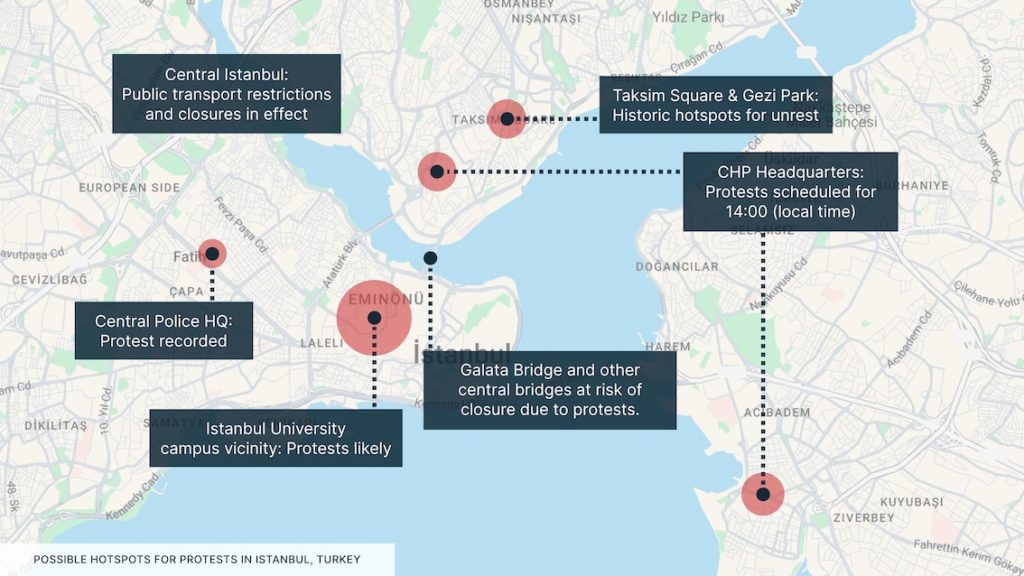
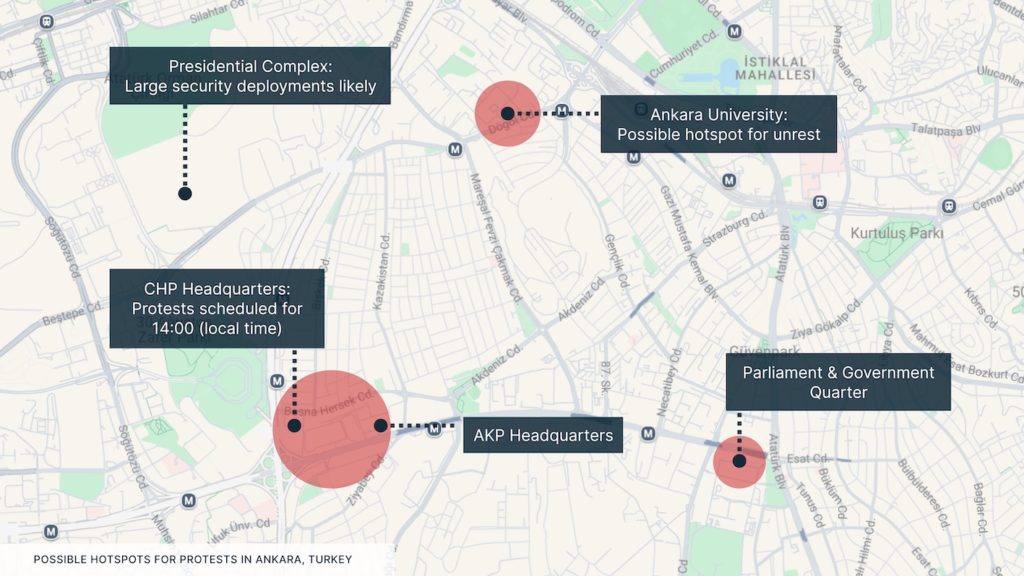
CHP leaders have organised multiple protests for 14:00 local time, including in Istanbul and Ankara. A gathering of protesters has been recorded at the central Istanbul police station as of the time of writing.
INTELLIGENCE ANALYSIS
Turkey Braces for Unrest as Opposition Vows Mass Protests
The arrest of Imamoglu is highly likely to provoke significant unrest, and it is almost certain to be perceived by opposition supporters as a move by the government of Recep Tayyip Erdogan to consolidate power and neutralise the opposition. Erdogan is constitutionally barred from running for president again, but it is likely that his Justice and Development Party (AKP) will field a constitutional amendment to prolong Erdogan’s presidency.
Protests are highly likely to concentrate in the centres of large cities, especially Istanbul. The CHP call for protests at the local party headquarters will almost certainly mean that these will be hotspots for gatherings of Imamoglu’s supporters. In addition to party offices, local universities are highly likely to be affected by unrest. Istanbul University is generally considered particularly liberal and is especially at risk as its students have in recent years launched several protests against its rectors, who are appointed directly by the president and are perceived to be excessively friendly to the government.
The authorities have closed Taksim Square metro station to limit the size of protests being organised near Taksim Square and are likely to close other stations.
Turkish police are highly likely to respond violently to any large gatherings and will also likely target isolated groups of protesters to prevent the formation of larger crowds. Turkish police employ harsh crowd-control measures including the use of tear gas, water cannons, and pepper spray. Arbitrary detentions of bystanders have been reported. Turkish authorities have previously used increased powers during periods of increased instability to detain foreign nationals who have engaged in or been near major protests.
Travel Risk Advice: Safety Guidelines for Greece
- Avoid all large gatherings. Limit travel in central Istanbul and Ankara due to the threat of protests. Avoid travelling to the vicinity of university campuses.
- Closely monitor local news reports and government alerts.
- Monitor the IETT website for live updates on transport in Istanbul.
- Plan for alternative routes and means of transport in Istanbul and Ankara. Allocate additional time for all travel
- If caught in a protest area, try to leave quickly if it is safe to do so.
- If you are in a crowd and unable to leave, take precautions to minimise the risk of crowd crush. These include staying upright, moving away from all hard barriers, going with and not against the crowd, and holding your arms at chest level in a boxer-like stance to relieve pressure.
- Increased security deployments are likely to continue throughout the four-day restrictions period (19-22 March). Disruptions are highly likely to be particularly severe during the weekend.
- Ensure that you always carry personal identification documents or copies.
- Have emergency contact numbers saved on your phone. These should include the local authorities, medical facilities and any consular support. Ensure that mobile phones are charged in case of any losses in electricity.
- Consider options to bypass internet restrictions or mitigate their impacts. This could include downloading useful resources ahead of travel and using a VPN and Tor Browser while in-country.
- Monitor the Solace Secure platform and trusted local media for updates relevant to the conflict.
Alert+
7.1-Magnitude Earthquake Strikes Tibet
Widespread Damage in Tibet: Earthquake Strikes Near Mount Everest
Intelligence cut off: 11:00 GMT 07 January 2025
At 09:05 local time (01:05 UTC) on 7 January, a powerful magnitude 7.1 earthquake struck Tingri County in southern Tibet. The epicentre was located approximately 80 kilometres north of Mount Everest at a depth of ten kilometres. The main tremor was followed by aftershocks of above 5.0 magnitude. The earthquake has caused widespread damage across Tingri County, including the city of Shigatse. Tremors were also felt in neighbouring countries, including Nepal and northern India, although no significant damage has so far been reported in these locations.
Initial reports confirm at least 95 fatalities and over 130 injuries, with more than 1,000 buildings damaged or destroyed. While the mountainous Tingri County is scarcely populated, approximately 7,000 people live within 20 kilometres of the epicentre. The city of Shigatse, the second largest in Tibet, has around 800,000 residents.
Local sources reported that the earthquake has disrupted local power and water supplies, and damage to local roadways has also been recorded. In January, the area has daily minimum temperatures of below -15 degrees Celsius, and daily average temperatures of -7.5 degrees.
The Chinese Air Force has initiated rescue efforts and deployed drones to the affected area. At least 1,500 firefighters and rescue workers have also been dispatched, alongside supplies including cotton tents, quilts, and folding beds.
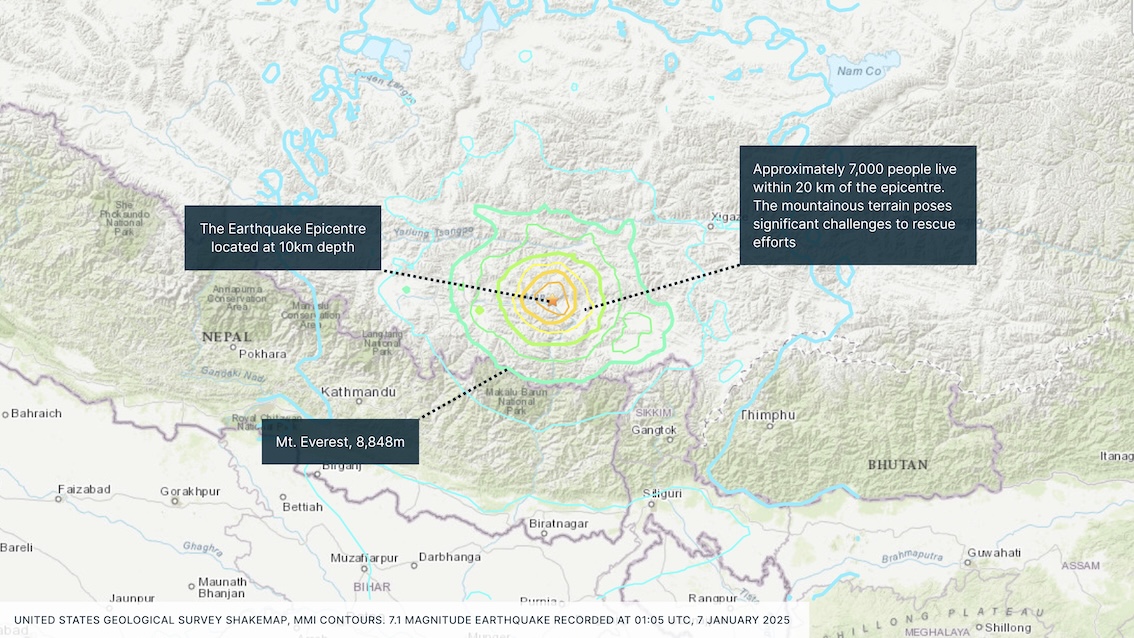
7.1 Magnitude earthquake recorded at 01:05 UTC, 7 January 2025. United States Geological Survey ShakeMap, MMI Contours
SOLACE GLOBAL COMMENT
Geological Context of 2025 Tibet Earthquake
The earthquake is one of the deadliest China has experienced in recent years. On 23 January 2024, a magnitude 7.0 earthquake struck Xinjiang, China. The death count was significantly lower, however, with only three deaths. In 2008, a large earthquake in Sichuan province killed nearly 70,000 people.
Southwestern regions of China are frequently affected by earthquakes. This is largely due to the region lying at the convergence zone of the Indian Plate and Eurasian Plate, which periodically releases tectonic stress as earthquakes. Furthermore, the region has numerous active fault systems including the Longmenshan Fault Zone, which triggered the 2008 earthquake, and the Xianshuihe Fault Zone.
The Lhasa block, also known as the Lhasa terrane, is a significant geological region in southern Tibet, situated between the Bangong-Nujiang suture zone to the north and the Indus–Yarlung Zangbo suture zone to the south. This positioning generates north-south compression, resulting in crustal shortening and uplift, as well as west-east stress, which drives lateral crustal movements. These geological processes play a crucial role in the formation of the Himalayas and significantly impact regional fault systems and seismic activity.
INTELLIGENCE ANALYSIS
Relief Challenges in Tibet: Topography, Aftershocks, and Political Scrutiny
While the United States Geological Survey measured the earthquake’s magnitude as 7.1, the China Earthquake Networks Center recorded a magnitude of 6.8. Differences in earthquake readings is relatively common due to the utilisation of different magnitude scales, algorithms, frequency sensitivity, distance from the epicentre, and the complexity of the fault movement.
Several aftershocks have already been felt in Tibet and Nepal; further aftershocks are highly likely in the coming days. While the aftershocks are unlikely to reach a similar magnitude to the initial earthquake, further aftershocks of approximately 5.0 magnitude may still occur. This could further damage structures that have already been weakened by the initial tremor and hinder relief efforts.
Power and water have been significantly disrupted in the region, which could further exacerbate humanitarian issues as residents cope with the aftermath. More deaths will almost certainly be confirmed as authorities verify fatalities amidst ongoing rescue efforts.
Shigatse, the closest city to the epicentre, is regarded as one of Tibet’s holiest cities and contains the Tashilhunpo Monestary which houses the seat of the Panchen Lama, a central figure in Tibetan Buddhism, second only to the Dalai Lama. It is an important pilgrimage site for Tibetan Buddhists. Furthermore, because of its proximity to the Nepalese border, it is an important trade hub. The earthquake will almost certainly disrupt trade through the region as recovery efforts continue.
The area is also a notable tourist site. Since Tingri county is located at the foot of Mount Everest, tourists often base themselves in the region. Mount Everest sightseeing tours have been cancelled in the aftermath. However, no significant damages were recorded at Mount Everest base camp.
The government’s response to the earthquake is likely to be viewed through the lens of historical Tibetan grievances. Given the mountainous topography of the region and potential aftershocks, relief efforts will likely be hampered, potentially opening the government up for criticism regarding its effectiveness at governing in the region. In the aftermath of the earthquake, there is a realistic possibility that those sympathetic to Tibetan independence will scrutinise the government response and call for self-determination.
Travel Risk Advice: Precautions for Tibet Erthquake Zones
- Closely monitor local news reports and government alerts
- Expect aftershocks. Be prepared to Drop, Cover, and Hold On in case of further tremors.
- During a tremor:
- If outside, avoid entering buildings. Move away from buildings, trees, streetlights, and overhead lines.
- If inside, pick a safe place, such as under a sturdy table or desk, or against an interior wall. Stay away from windows and heavy furniture. Do not leave until the shaking stops.
- If evacuating a building, always use the stairs.
- Be alert to fires and falling debris.
- Adhere to all instructions issued by authorities.
- Follow evacuation orders and travel to government-designated shelters if it is safe to do so.
- Ensure important documents and medications are safely stored.
- Prepare an emergency “go bag” with essentials, including bottled water, batteries, important documents, and medications.
- Confirm flights are operating before checking out of hotels or travelling to the airport.
- Prepare for potential power outages, communication disruptions, and travel delays.
- Avoid damaged buildings and affected areas until authorities declare them safe.
- Management should maintain communication with affected individuals until the situation is fully resolved.
Subscribe to free weekly intelligence
US speaker Nancy Pelosi visits Taiwan
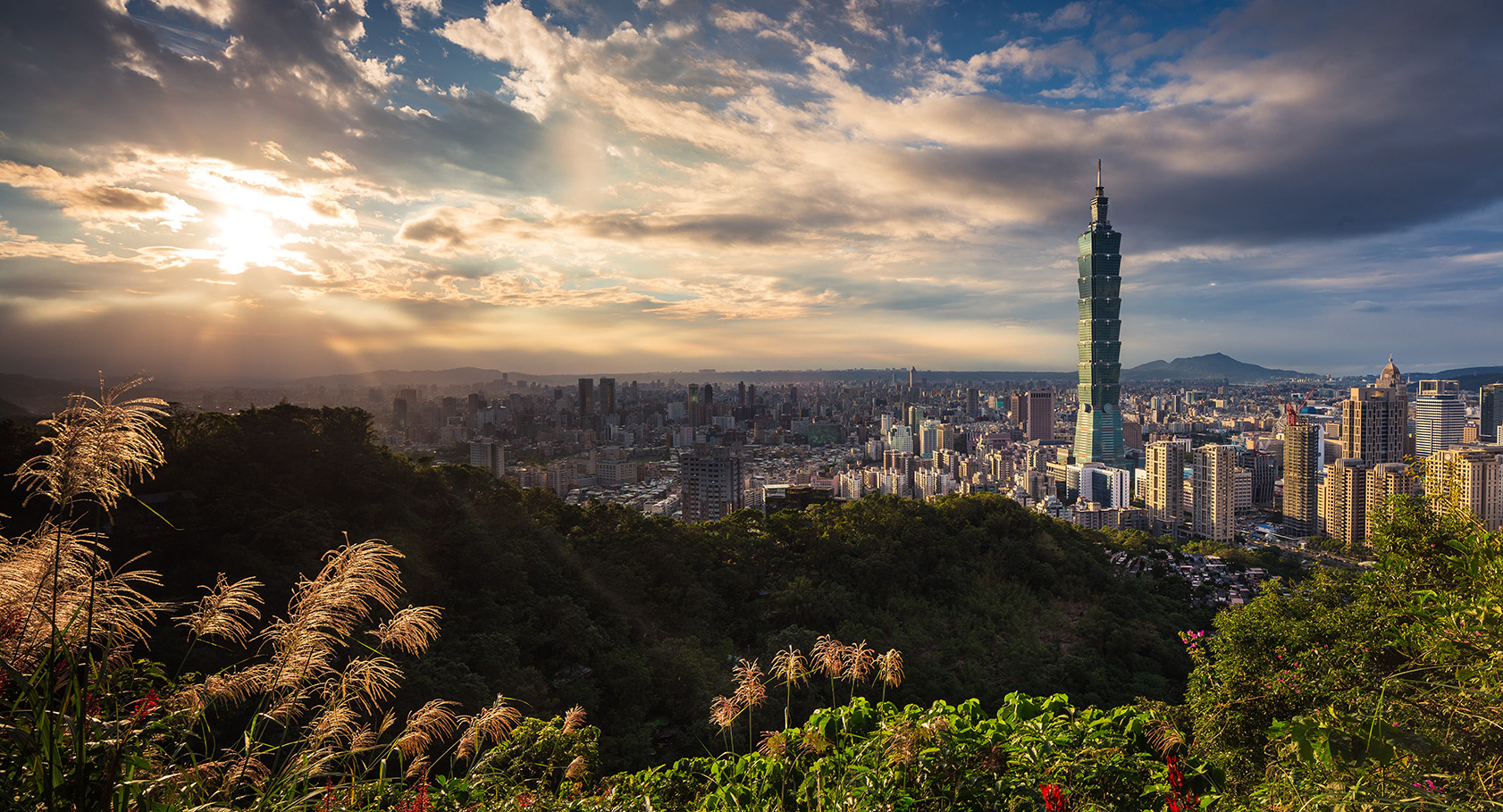
Situation Summary
A delegation of American politicians, including House Speaker and senior Democratic politician Nancy Pelosi, landed at Taipei Shongshan Airport in the Republic of China (ROC, or Taiwan) on 2 August. The visit to Taiwan comes amidst an ongoing tour of the Asia-Pacific by the high-profile delegation, which has been conducted for the purpose of reaffirming American commitments to the region. Countries such as Singapore, Malaysia, South Korea, and Japan were included on the official itinerary list, but the visit to Taiwan was hidden, likely out of concerns that any official confirmation would prompt a harsh response from the People’s Republic of China (PRC, or China).
Intelligence suggesting that Nancy Pelosi would visit Taiwan prompted a series of warnings from the Chinese government and state media broadcasters. China warned that any visit to Taiwan would be considered as a provocation that would necessitate a diplomatic and, in some communications, military response from Chinese authorities. Speculation of Nancy Pelosi’s visit prompted China to engage in aggressive military maneuvers in the Taiwan Strait during the morning of 2 August, including the positioning of warships and aircraft along the contested Median Line. A Distributed Denial-of-Service (DDoS) attack was later recorded against the website of Taiwan’s presidential office.
Four US Navy warships, including the USS Ronald Reagan aircraft carrier and the USS Tripoli amphibious assault ship, have been operating east of Taiwan. US officials have stressed that their positioning was prompted by a “routine deployment”, but US military authorities remain on high alert due to the increased risk of miscommunication and miscalculation stemming from the elevated number of both US and Chinese military assets in the region.
In response, Chinese authorities announced three-day military drills will commence near Taiwan from 4 August.
Solace Global Comment
Nancy Pelosi’s visit to Taiwan represents the most senior visit by a US official since the visit of House Speaker and Republican politician Newt Gingrich to Taipei in 1997. Newt Gingrich’s visit prompted irritation within China but was tolerated at the time. Since 1997, however, China’s role in the global economy has grown exponentially, and China has begun to exercise a more assertive role in both regional and global diplomacy. There is now an increased willingness within the Chinese government to adopt a more hawkish stance towards Taiwan, which is actively considered to be one of China’s core national interests, alongside increasingly bellicose rhetoric regarding reunification.
Taiwanese self-governance and the perception of Taiwan as an integral territory of China has prompted the Chinese government to enforce a ‘One China’ policy in its global relations; a practice which the US has acknowledged since President Richard Nixon’s decision to thaw relations between the US and China in 1972. Despite this, the incumbent Chinese Foreign Minister Wang Yi has accused US President Joe Biden of conducting a “fake” One China policy, and Chinese President Xi Jinping has warned the US “not to play with fire” over the legal and diplomatic status of Taiwan.
Although an invasion of Taiwan remains highly unlikely in the near-term due to the complexity of an amphibious assault across the Taiwan Strait, geopolitical and economic impact, and the potential for US involvement in the conflict, Nancy Pelosi’s visit is certain to escalate tensions further and will very likely lead to an increased Chinese military presence in the region over the coming weeks. Chinese officials have likely calculated that there is a need to reassert Chinese credibility over their red lines in Taiwan, given the current trajectory of US-Taiwan relations. A further military response remains realistically possible, such as live-fire exercises, significant naval and aerial posturing off Taiwan, or potentially missile tests in the vicinity of the Taiwan Strait. A Taiwanese response should be anticipated, and the potential for miscalculation should not be ruled out. China may also seek to conduct retaliatory actions towards the US through economic levers.
Solace Global Advice
•In the event of a significant security development, travellers in Taiwan should follow any instructions issued by the Taiwanese government.
•Political tensions may disrupt airspace in both China and Taiwan. It is advised to monitor flight information and check with your travel provider if you are unsure of the status of your flight.
•Instances of civil unrest within Taiwan cannot be ruled out. Travellers should avoid all demonstrations and large public gatherings as they may escalate quickly and without warning.
•Areas where political figures are known to gather are likely to be focal points for political activism and unrest, especially sites due to be attended by Nancy Pelosi or other delegates. You should be particularly vigilant in these areas and follow any specific advice from the local security authorities.
•Expect localised travel disruption and an enhanced security force posture in the short-term as Taiwanese authorities increase measures to protect the US delegation.
• Be aware that China may seek to retaliate for Nancy Pelosi’s visit within the economic, cyber, and diplomatic domains, which could place additional restrictions on business operations and travel within China, Taiwan, and the wider region.
• Make sure you are familiar with contact details for the emergency services (in Taiwan – dial 110 for the police, 119 for medical assistance or the fire brigade).
• Exercise increased caution, remain vigilant, be aware of your surroundings and report any suspicious activity to security personnel as soon as possible.
• If caught in the vicinity of a security incident, seek shelter immediately and leave the area if safe to do so. Continue to adhere to all instructions issued by authorities and obey the security cordon in place.
• Report any suspicious items and behaviours to the nearest security or police officials.
• Monitor the Solace Secure platform and local media for updates.
Understand the situation with bespoke intelligence
Be in the know with intelligence reports built directly around your operational requirements.
Pyeongchang Olympics Risk Summary

The Winter Olympics is set to begin in Pyeongchang, South Korea on 09 February. Travel to the country brings a unique set of challenges and issues to overcome. For more on the Olympics, how to prepare and, what to expect when travelling to South Korea, please take a look at our risk summary below or download this information as a PDF from the following link: Solace Global – Event Advisory – Pyeongchang Olympics Risk Summary
THE ROAD TO PYEONGCHANG…
- 16 Oct 2009 – Pyeongchang submits bid to host games
- 06 Jul 2011 – Pyeongchang selected as winner
- 24 Oct 2017 – Olympic Torch Relay commenced
- 09 Feb 2018 – Olympics Opening Ceremony
- 25 Feb 2018 – Olympics Closing Ceremony
- 09 Mar 2018 – Paralympics Opening Ceremony
- 18 Mar 2018 – Paralympics Closing Ceremony
OPERATING ENVIRONMENT KEY FACTS
- Estimated 43,703 (Pyeongchang County, as of 2014)
- Population: 219,274 (Gangneung Metropolitan Area, as of 2012)
- Geographic Area: 1,464 Km² (Pyeongchang County) 1,039.99 km² (Gangneung Metropolitan Area)
- Language: Korean
- Religion: Non-religious/traditional beliefs, Christianity, Buddhism
- Weather: Cold & temperate (Pyeongchang) Warm & temperate, heavy rainfall (Gangneung)
- GMT: +9
- Capital: Seoul
- Currency: South Korean Won
- Emergency Services: 119 (Fire & Medical) 112 (Police)
PYEONGCHANG OLYMPICS KEY FACTS
COUNTRIES: 94
A record 94 countries are sending athletes to the 2018 Games. With North and South Korea competing under one flag. The Korean women’s ice hockey team will feature athletes from both countries. 2018 has seen a thawing of interKorean relations, after high tensions throughout 2017.
ATHLETES: 2,900
More than 2,900 athletes will compete at the Games. Russia has been banned from attending but more than 160 Russians will compete under the Olympics flag. The United States will send the most athletes, with nearly 250 planned competitors.
TICKETS: 1.07MILLION
1.07 million tickets for the Games will be on sale. So far, about 75% have been sold. The figure is lower than in comparison with Sochi 2014. Security is the most prominent factor contributing to a lack of sales, though the Russian doping scandal and a lack of local interest have also been contributing factors.
SECURITY: 5,000
North Korean unpredictability remains the most obvious security challenge. 5,000 members of the military will be deployed for the Games. There are also plans for 15,000 volunteers to support the running of the Games.
OLYMPIC VENUES: 13
The events for the Games will be in Gangwon Province. Specifically in the Pyeongchang Mountain Cluster (snow events), Jeongseon (alpine speed events), and Gangneung (ice events).
LOCAL ETIQUETTE
- Business dress is strictly formal; men generally wear dark suits, and women, typically modest dresses. Although this may later be relaxed, adherence to this code is advisable for early meetings. Dressing well is considered a sign of respect.
- It is customary to greet people with a bow from the waist. A handshake may also be a substitute. More established acquaintances typically abbreviate the bow to a nod of the head.
- When taking something from an older or senior person always use two hands; if you must use one hand, you should support your right arm with your left hand. This extends to the exchange of business cards. Another convention is to support your right arm with your left hand when shaking hands with somebody older or more senior. When talking to someone older, direct eye contact should generally be avoided.
- Korean society places great emphasis on “face”. Embarrassing situations are to be avoided, or downplayed, as much as possible. This also makes it unusual to receive an apology if someone bumps into you.
- Buddhist temples often display Swastikas. It originates as a local religious or spiritual symbol and has no connection to the Third Reich or Nazism.
- Initial conversations are likely to cover a great deal of breadth rapidly; this may include questions about family, career, age, and education. This is not seen as intrusive, however brief answers are acceptable if you do not wish to divulge excessive detail.
- Tipping is not expected in South Korea (but is welcomed), however a service charge of around 10% may be charged (compulsory) by hotels.
- Bargaining is acceptable at open markets, but not so welcomed in shops and stores.
- At some restaurants, you are required to take off your shoes before entering the dining area (usually a wooden floored area). If going to the bathroom, you should use sandals which are usually provided.
- If you are an important guest, it can be considered rude to pour your own drink, and this must be poured for you by the person sitting next to you. If you are not an important guest, you should pour another’s drink before pouring your own.
- Do not raise bowls to your mouth when eating. Leave the table to blow your nose and do not make any loud noises at the table.
- The number four is considered unlucky (tetraphobia) due to its similarity to the Chinese character for death (common in East Asian nations). Even giving gifts in multiples of four is unadvisable. Contrarily, the number seven is considered lucky.
- Kissing in public is discouraged, especially around older Koreans, as it is considered highly immodest.
- Physical contact can be considered a personal violation, this includes back slapping and patting. Unless you have a very close relationship with someone, it is advisable not to touch them.
SCAMS
- Fake Hotel Scams: South Korea has the world fastest internet connections and the greatest internet penetration. Accordingly, a proportional amount of criminal activity and scams are based online. Travellers frequently are targeted by false websites offering modern hotels at low prices. Upon arrival, the hotel either does not exist, or is poorly maintained or an unregistered bedsit. Travellers are advised to undertake proper due diligence on any accommodation or book through a reputable agency.
- Begging: Foreigners in South Korea can be specifically targeted by beggars who may solicit donations forcefully or apply pressure through unsolicited physical contact. Avoid giving any indication of where your wallet or cash is stored in case they are seeking to distract you for a pickpocket.
- The ‘Taxis Parked in Front of Your Hotel’ Scam: In front of many four & five-star hotel there are taxis waiting all day. Despite appearances, these taxis are not associated with the hotel. These drivers may not switch on their meters when picking up passengers and instead insist on an excessive charge whilst already in motion. Travellers should be aware of taxis which wait outside of hotels. If you need a taxi, ask your hotel to order one for you from a reputable company and ensure they meter your journey. If the vehicle has a meter, it should be used, if not, agree the price before setting off.
- The ‘Tour guide’ Scam: A traveller will be approached by a friendly local who speaks good English and has some anecdotes about the traveller’s country of birth. They offer to take the tourist on a tour for a tiny price. For the whole excursion, they seem genuine and kind, however will make efforts to steer travellers towards businesses owned by relatives or friends, who will then pressure the travellers to purchase merchandise at heavily elevated prices. Travellers should be cautious of strangers with intentions too good to be true; invariably they are. If you wish to take a sightseeing tour, prearrange through a reputable agent.
- Overcharging: Travellers should be aware that foreigners can be overcharged while shopping. This can be intentional or unintentional (inability to read or understand labels). In restaurants, adhere to dishes on the menu and check the bill prior to payment.
- Racism: Travellers to, and foreign residents in, South Korea have noted a prevalence of racism within the country. Travellers should note that, unlike many countries in the west, South Korea is ethnically homogenous, with more than 99 percent of inhabitants having Korean ethnicity. The judiciary in South Korea have been accused of being heavily biased against foreigners. If there is a dispute with a local, the law will almost always rule in favour of the local against the foreigner. Even if physically assaulted by a local, it is possible that retaliation will cause significant legal problems. For road traffic accidents or incidents of dispute, it is important that a Korean speaker or Korean local is contacted, in order to get both sides of the story.
SECURITY SUMMARY
South Korea, or the Republic of Korea (ROK), holds a geographically and politically important position in the region. The country has excellent relations with the United States, China, and increasingly, with Japan. The ROK’s most substantial threat comes from the aggressive North Korea, or the Democratic People’s Republic of Korea (DPRK).
The ROK’s alliances are mainly used to help manage the continued threat from the DPRK. ROK-DPRK relations have improved somewhat since the beginning of the year, with both Koreas to march under one flag at the opening ceremony.
Both sides of the demilitarised zone maintain some degree of communication. Indeed, President Moon, elected in 2017, has sought to offer an olive branch to South Korea’s northern neighbour, returning to the ‘Sunshine Policy’ (to a large extent) of the post-millennium leadership in Seoul.
Throughout 2017, Pyongyang has tested a series of missiles including those which passed over Japan. More concerningly, in early September 2017, the DPRK conducted its most powerful nuclear test to date, causing a 6.3- magnitude earthquake. While low-level border skirmishes have taken place historically, especially over the disputed Yeonpyeong Islands, the chances for an imminent return to full-blown conflict before or during the Olympics remain unlikely. This is due to the present relationships. The US maintains a force of nearly 30,000 personnel in the ROK to assist in the country’s defence. Also, North Korea maintains a largely friendly relationship with China and Russia which are both sending athletes to compete in the Games (the latter under a neutral flag). Moreover, North Korea athletes, including two figure skaters, are due to compete at the Games.
These facts ensure that the risk of a DPRK missile attack during the Games is LOW.
GENERAL TRAVEL ADVICE
Although South Korea can be considered very safe (especially in terms of crime and terrorist threat), it is advisable to remain aware of your surroundings to at least the same degree as you would in any other developed country.
Take extra care of passports, credit cards and wallets/purses when in crowded or tourist areas. Take extra care when travelling alone or at night, and make sure to use a legitimate means of transport such as public transport or metered taxis.
Be sure to carry a form of ID as well as details of your next of kin. Avoid carrying any valuables in a backpack as this is an easy target for thieves.
When air pollution is high, follow local advice and stay hydrated, indoors, with the windows closed when possible.
South Korean security forces often hold Civil Emergency Exercises in major cities, usually involving evacuation to a safe area such as a metro station. Although you do not have to participate as a foreign national, it is best to follow the instruction of the authorities when the sirens sound indicating an exercise. Be aware that the judiciary has been accused of being biased against foreigners and will nearly always side with locals in any disputes.
There are heavy penalties for drug offences, even for personal use, and foreign nationals can be detained purely on the basis of drug tests.