Evacuations from High-Risk Locations Call +44 (0)1202 308810 or Contact Us →

When is country or city risk intelligence not enough?
Explore eight signs that a traveller may need a tailored pre-travel advisory.
What is tailored travel intelligence?
Tailored travel intelligence is analysis developed around a specific traveller and journey rather than a destination in isolation.
A pre-travel advisory can consider the traveller’s profile, exact itinerary, routes, accommodation, planned activities and current developments. The aim is not to provide more information for its own sake. It is to identify the information relevant to the decision being made and translate it into practical guidance.
For organisations managing business travel, this can support travel approvals and duty of care. For executive security teams and family offices, it can also help determine whether existing arrangements remain proportionate to the individual and their movements.
So when should security teams consider moving beyond standard country and city intelligence?
1. The traveller has a higher profile
The same destination can present different considerations for different people.
A senior executive, public figure, family office principal or individual associated with a recognisable organisation may attract greater attention than a routine business traveller. Their role, public visibility, professional associations or planned engagements can change the nature of their exposure without changing the underlying country risk rating.
This does not automatically mean protective security is required. It means the individual profile should form part of the assessment.
A tailored pre-travel advisory can examine whether that profile introduces considerations that would not be apparent from destination intelligence alone.
2. The itinerary is more complex than the destination
Country and city risk assessments answer an important question: what is the operating environment like?
A complex journey creates another: what will the traveller encounter between each point?
A trip may involve several cities, regional facilities, remote project sites, unfamiliar airports or long periods of overland travel. Conditions can vary significantly across one itinerary.
The routes themselves may also matter. Road quality, checkpoints, demonstrations, transport disruption or access to medical support can all affect the practical risk of a journey.
Where an itinerary extends beyond familiar locations, tailored analysis can provide a clearer view of the journey as a whole.
3. The purpose of travel changes the exposure
Where someone is travelling is only part of the picture. What they are going there to do can be equally relevant.
Consider two travellers arriving in the same city on the same day.
One is attending internal meetings at an established corporate office. The other is visiting a remote facility, attending a public event, meeting government representatives or carrying out sensitive work.
Their destination risk may be identical. Their exposure is not.
A tailored travel risk assessment can consider the activities planned during the trip and identify whether they introduce additional security, reputational or operational considerations.
4. Conditions are changing around the dates of travel
Standing country and city intelligence gives decision-makers an understanding of the wider environment. Some journeys, however, take place at a point when conditions are changing quickly.
Examples include elections, planned demonstrations, significant political developments, severe weather, transport disruption or a developing security incident.
In these circumstances, the question is no longer simply:
“What risks exist in this destination?”
It becomes:
“What could affect this traveller, in these locations, during these dates?”
Time-specific intelligence can help security teams understand whether the itinerary should proceed as planned, whether the traveller needs additional information or whether reasonable adjustments should be considered.
5. Several moderate risk factors overlap
Not every tailored assessment is triggered by a single significant threat. Sometimes, the combination of several factors warrants closer analysis.
A traveller may have a moderately elevated profile. Their itinerary may include an unfamiliar road movement. Their visit may coincide with demonstrations. They may also be attending a public-facing event.
None of those factors necessarily changes the decision in isolation.
Together, they may.
This is where analyst judgement adds value. Rather than treating each risk factor separately, tailored intelligence considers how they interact and what that means for the traveller.
6. The impact of disruption would be significant
Travel risk assessment should consider not only the likelihood of an incident, but also its potential impact.
A journey involving a CEO ahead of a major transaction, a principal travelling with family members or a team operating within a narrow project window may warrant additional planning even where the destination itself is not considered particularly high risk.
The aim is not to overstate the threat.
It is to understand the consequences if the journey does not go as planned and determine whether reasonable contingency measures should be in place.
For some travellers, a relatively modest disruption can have a disproportionate operational, financial or personal impact.
7. Additional security measures are being considered
Intelligence should inform security measures, rather than simply justify them after a decision has already been made.
If an organisation or family office is considering secure transportation, journey management, enhanced monitoring, additional check-ins or close protection, a tailored assessment can help determine what is proportionate to the circumstances.
For example, analysis may identify that changing an airport transfer route and monitoring a particular event is sufficient. In another situation, the profile of the traveller and operating environment may support a higher level of security.
The objective is the same in both cases: match the response to the assessed exposure.
This also avoids the assumption that travel to a higher-risk destination automatically requires the highest level of protective security.
8. The traveller needs guidance specific to their journey
Security teams now have access to significant volumes of intelligence. More information does not always lead to a better decision.
The more useful question is:
Does the traveller know what matters to them?
A lengthy destination report may contain valuable intelligence, but the individual may need only a small proportion of it to make informed decisions during their journey.
Tailored intelligence can translate the wider operating picture into practical guidance: what to be aware of, where additional caution may be appropriate, what could affect the itinerary and what action to take if circumstances change.
For an executive travelling on business, this could relate to particular meetings, routes and locations.
For a family office, different family members could require different advice despite travelling within the same country.
The value lies in making intelligence relevant to the person receiving it.
Country intelligence, city intelligence or a pre-travel advisory?
These intelligence products should not be viewed as alternatives competing with one another. Each provides a different level of context.
| Intelligence | Best suited to |
| Country risk intelligence | Understanding the wider political, security, health and operating environment |
| City intelligence | Identifying local conditions and differences within a destination |
| Tailored pre-travel advisory | Understanding how the traveller, itinerary, timing and purpose of travel affect exposure |
A routine journey to a familiar location may be well supported by current country and city intelligence.
A complex itinerary involving a high-profile traveller during a period of changing conditions may warrant considerably more context.
The appropriate level should reflect the circumstances of the journey and the organisation’s or individual’s risk tolerance.
Turning intelligence into informed action
Effective travel risk intelligence should help answer three questions:
What is happening? What does it mean for this traveller? What, if anything, should we do differently?
At Solace Global Risk, country and city risk intelligence provides the wider operating picture, while tailored pre-travel advisories consider the individual traveller and itinerary.
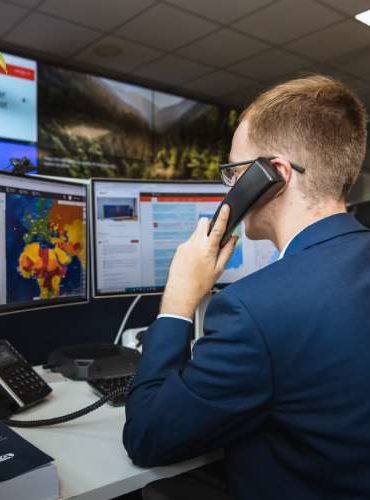
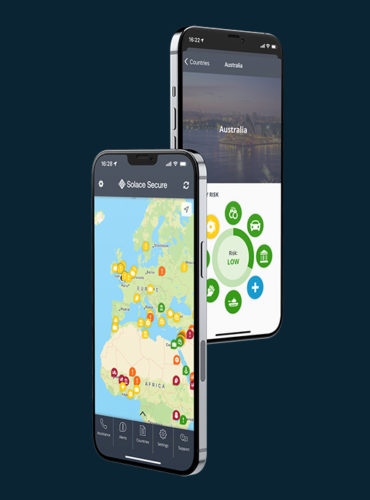
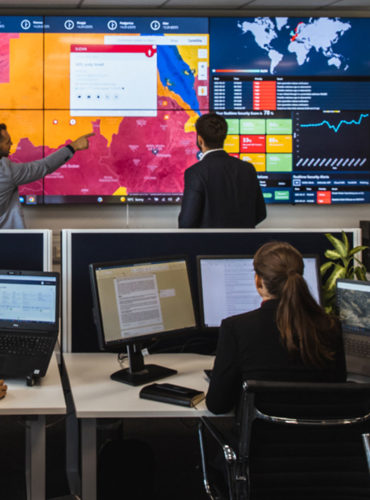
Our intelligence analysts work as part of an integrated travel risk management model alongside Solace Secure and our 24/7 Global Security Operations Centre. This enables intelligence to support planning before travel, monitoring during the journey and coordinated response where required.
Planning upcoming travel where the individual, itinerary or environment requires a closer assessment?
FAQs
What information is needed for a tailored pre-travel advisory?
The quality of a PTA depends on the context available to the analyst. Useful information can include the traveller or group profile, dates of travel, flight details, accommodation, destinations, planned routes, sites being visited, purpose of travel and any existing security arrangements. The more accurately the journey can be understood, the more relevant the intelligence and recommendations can be.
Does every higher-risk journey need a tailored advisory?
No. A higher country risk rating should inform the assessment, but it should not automatically determine the response. Existing experience, established security arrangements, traveller profile, exact locations and current conditions should all be considered. Equally, a journey to a comparatively lower-risk destination could justify additional analysis if the traveller or activity introduces a different form of exposure.
The trigger for tailored travel intelligence is not simply a high-risk destination. It is when standard destination intelligence no longer provides enough context for the decision being made.
What is the difference between a country risk assessment and a tailored pre-travel advisory?
A country risk assessment provides an overview of the wider political, security, health and operating environment. A tailored pre-travel advisory applies that intelligence to a specific traveller, itinerary, purpose and travel dates to provide more relevant guidance.
When should a business consider tailored travel intelligence?
Tailored travel intelligence may be appropriate when a traveller’s profile, itinerary, activities or timing creates considerations that standard destination intelligence does not fully address. This could include complex itineraries, high-profile travellers, changing local conditions or several overlapping risk factors.
Can a traveller need a pre-travel advisory for a lower-risk destination?
Yes. Destination risk is only one part of the assessment. A traveller’s profile, planned activities, routes, public visibility or the potential impact of disruption can justify additional analysis even when the overall country risk is comparatively low.
How does tailored travel intelligence support duty of care?
Tailored intelligence helps organisations assess the risks associated with a specific business trip and provide travellers with information relevant to their circumstances. It can support travel approvals, pre-travel preparation and decisions around additional security or monitoring.
Can a pre-travel advisory help determine what security measures are needed?
Yes. A tailored assessment can help determine whether measures such as secure transportation, journey management, enhanced monitoring or close protection are proportionate to the assessed exposure. Intelligence should inform the security response rather than assume a particular level of protection is required.
How does travel risk intelligence support travellers during a trip?
Pre-travel intelligence establishes an informed picture before departure, while ongoing monitoring can identify developments that may affect the traveller or itinerary. When integrated with a 24/7 Global Security Operations Centre, intelligence can also support coordinated assistance and response if circumstances change.

Speak to our team about tailored travel intelligence
Is It Time to Scale Your Executive Protection Programme?

Aligning protection with modern travel risk management and corporate travel security
7 Signs Your Corporate Travel Security Programme Needs to Scale
The sign: Your organisation subscribes to threat intelligence and receives alerts. But when a major incident occurs, there is no pre-agreed plan, no confirmed resource, and no provider with a contractual obligation to act. Intelligence without response capability Without a response capability in place, organisations may find themselves making critical decisions and sourcing support at the same time.
Why it matters: The geopolitical volatility of 2026 has exposed this gap at scale. When Operation Epic Fury, the US-led military campaign against Iran, triggered rapid airspace closures, Iranian retaliatory strikes, and mass displacement across the Middle East, organisations with fragmented security arrangements were left scrambling. Traveller tracking, close protection, and emergency response sat with different vendors who had no shared protocol and no obligation to coordinate. Employees were stranded. Evacuation costs surged. Those without pre-negotiated crisis evacuation plans faced significantly higher fees – and significantly longer exposure windows – than those with an integrated response structure already in place. When mass numbers attempt to evacuate simultaneously, the market for seats, logistics, and ground support dries up fast.
Ask yourself: Do you have a provider with a confirmed commitment to respond, not just report, in a crisis? Have you tested that commitment against a worst-case scenario?
The sign: When a crisis hits, whether from a natural disaster, civil unrest, or a security incident, your team spends critical minutes establishing who is where, rather than responding. And that problem is no longer limited to international travel. With hybrid working now standard, the same visibility gap exists domestically: do you know, at any given moment, who is in the office and who is working remotely?
Why it matters: Real-time visibility across your entire workforce – travelling executives, employees on international assignments, and staff working from home or third-party locations – is an important part of duty of care. A travel risk management app that provides live tracking, journey monitoring, and two-way communication tools can build the full picture of where your people are, not just those on booked itineraries.
Ask yourself: If an incident occurred right now, could you accurately account for every employee – those abroad, those travelling domestically, and those working remotely?
3. Your Duty of Care Framework Has Not Been Updated for Current Threat Levels
The sign: Your duty of care policies were written for a different risk environment. They may not account for geopolitical tensions (a concern for 46% of organisations), regional conflicts (43%), or the growing expectation from employees that their employer will actively protect them – not just have a policy on file.
Why it matters: Employee expectations have never been higher. Employers deemed in breach of their duty of care face not only legal liability but reputational damage that can affect their ability to attract and retain talent. The potential cost of failure far exceeds the cost of building a robust programme.
Ask yourself: How do you define duty of care for your employees? Has that definition kept pace with today’s threat landscape?
4. Your Emergency Response Plan Has Never Been Tested
The sign: You have a plan. But it hasn’t been validated recently against a realistic worst-case scenario – a terrorist attack, a natural disaster, or civil unrest in a market where your senior leaders are present.
Why it matters: Many emergency response policies contain restrictions that organisations are unaware of. Insurance providers may not cover war zones, terrorist attacks, or natural disasters – gaps that only become apparent under pressure. A 24/7 Global Security Operations Centre (GSOC) that has been tested and validated provides the continuity and confidence that a paper plan cannot.
Ask yourself: Have you tested your emergency response plan with your current provider to validate they have the resources to respond in a worst-case scenario?
5. Intelligence Is Not Informing Pre-Travel Planning
The sign: Your security briefings are generic. Travellers receive country-level advisories rather than contextual, event-specific intelligence that shapes routing, accommodation choices, and on-the-ground protocols.
Why it matters: An intelligence-led approach to executive protection is what separates organisations that prevent incidents from those that merely respond to them. Today’s threats rarely occur in isolation – one major event triggers a cascade of others. Pre-travel planning grounded in current threat intelligence significantly reduces exposure.
Ask yourself: Where have your executives or travelling employees felt most vulnerable in the past 12 months? What intelligence would have changed their behaviour?
6. Your Corporate Brand Is Increasing Exposure
The sign: Your organisation’s profile, whether through public-facing leadership, high-value contracts, or geopolitical associations, is raising the risk level for your executives. But your protection programme has not evolved to reflect this.
Why it matters: Corporations increasingly recognise that their brand and reputation can expose employees to risk both domestically and internationally. High-profile leadership, media attention, or operations in sensitive regions all alter the threat calculus. Executive protection must be calibrated to the organisation’s specific risk profile.
Ask yourself: Could your company’s brand or the public profile of your senior leaders make them a target? Has your protection programme been assessed against that reality?
7. Your Programme Structure Slows Response When Speed Is Critical
The sign: During your last significant incident, your team spent time establishing who was in charge, which provider to call, and what the escalation path was – before any response could begin. Ownership was unclear. Handoffs were delayed. The programme itself became an obstacle.
Why it matters: Unclear escalation paths and multiple points of contact have a direct operational cost during a crisis. When close protection, travel risk management software, and GSOC support operate within a single coordinated model under one point of contact, organisations move from insight to action without delay. Where that structure does not exist, the gap shows, particularly in fast-moving, large-scale incidents where every hour of indecision carries consequences.
Ask yourself: In your last significant incident, how much time elapsed between the alert and the first coordinated response? Where did that time go?
Scaling Executive Protection: The Integrated Model
Scaling effectively requires bringing the right elements together into a structure with clear ownership and tested capability.
- Intelligence ensures threats and changing conditions are understood in context, supporting pre-travel planning and measured incident response
- Technology – through a travel risk management app or travel risk management software – provides tracking, communication, and real-time reporting across all journeys
- Operational capability through an outsourced Global Security Operations Centre provides 24/7 monitoring, coordination, and a single point of control
Together, these create a resilient model where executive protection supports both routine business travel and complex, high-risk environments – with one point of contact, clear accountability, and continuity from planning through to response.
Reviewing Your Corporate Travel Security Programme
Solace Global Risk supports organisations in developing and scaling executive protection programmes aligned with modern travel risk management requirements.
If any of the signs above reflect your current position, we can help you assess your programme and identify practical next steps – before an incident makes the decision for you.
THE GLOBAL RISK PODCAST
Listen: Is It Time to Scale Your Executive Protection Programme?
Executive protection is no longer reserved for a small number of high-risk journeys. In this episode, Amy Stone explores seven indicators that your executive protection and travel security programme may need to evolve, and what a modern, integrated approach looks like in practice.
Frequently Asked Questions (FAQs)
What is executive protection?
Executive protection is the organised security provision designed to protect senior personnel — and in some cases their families — from threats arising from their position, profile, or operational environment. It typically encompasses advance planning and security surveys, close protection officers, secure transportation, intelligence briefings, and 24/7 GSOC monitoring. Under ISO 31030:2021, executive protection is a component of a broader travel risk management programme, calibrated to the specific risk profile of the individual and the environment in which they are operating.
How does ISO 31030 apply to executive protection programmes?
ISO 31030:2021 is the international standard for travel risk management. It provides the framework within which executive protection programmes should sit: from risk identification and pre-travel authorisation through journey management, incident response, and post-travel review. The standard identifies personnel risk — including assault, detention, and kidnap — as a core risk category (Section 6.2), and requires that protective measures are proportionate to the traveller’s profile and risk exposure. Organisations with programmes aligned to ISO 31030 are better positioned to demonstrate duty of care compliance and to respond proportionately when conditions change.
What is the difference between executive protection and close protection services?
Close protection services refer specifically to the provision of trained protective personnel — commonly close protection officers — deployed alongside an individual or group. Executive protection is the broader programme: it encompasses close protection as one operational element, alongside intelligence, advance work, secure transportation, route planning, GSOC monitoring, and crisis management coordination. A close protection officer on the ground operates most effectively within a programme that has structured intelligence support and clear escalation protocols behind it.
When should an organisation review its executive protection programme?
ISO 31030:2021 recommends regular review of travel risk management arrangements to reflect changes in the risk environment, the organisation’s risk appetite, or the profile of the travelling population (Annex A, Stage 4). In practice, a programme review is warranted after any significant incident, following a change in the organisation’s operational footprint, when the seniority or public profile of key personnel has changed materially, or if the current provider’s capability has not been tested against realistic scenarios. Organisations that review programmes proactively — rather than in response to an incident — typically encounter lower costs and shorter resolution windows.
What role does a Global Security Operations Centre play in executive protection?
A Global Security Operations Centre (GSOC) provides the monitoring, intelligence, and coordination layer that connects the individual elements of an executive protection programme into a functioning response capability. It tracks traveller locations, monitors threat intelligence feeds, issues alerts, and acts as the central point of coordination between on-the-ground protective personnel, intelligence analysts, and the organisation’s own security teams. Within the ISO 31030 framework, the GSOC fulfils the requirement for proactive monitoring, clear escalation procedures, and integrated incident management (Annex A, Stage 3).
What travel risks are most relevant to executive protection in 2026?
The highest-rated concerns among corporate security teams currently include geopolitical instability — including rapid escalation events, airspace closures, and sanctions-driven access restrictions — rising levels of crime in major business hubs, kidnap and extortion risk in certain regions, and targeted threats arising from an organisation’s public positioning or senior leadership profile. ISO 31030:2021 lists personnel risk categories as injury, assault, detention, kidnap, theft, robbery, and death (Section 5.5), alongside legal, reputational, and financial risk categories that may arise where travel risk management arrangements are inadequate.
Contact Solace Global Risk to arrange a programme assessment
Solace Global at CSO 360

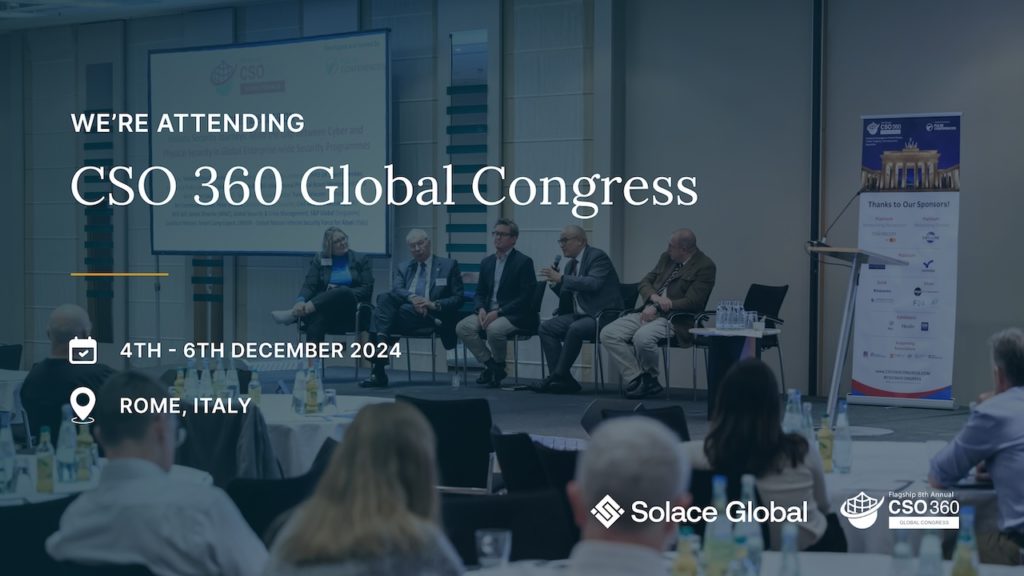
Join us at CSO 360 in Rome
We are excited to announce that we will be attending the CSO 360 Global Congress in Rome, where we will be participating in a key panel discussion focused on the future of risk management and security.
We’re thrilled to be joining top security professionals and industry leaders from around the world, engaging in conversations about the latest developments in global security and innovation.
OUR PANEL DISCUSSION
The Future of Security with AI, Machine Learning, and Data
Join us for our panel discussion on “How CSOs Envisage Using AI, Machine Learning & Data to Support Future Risk & Security Management” and discover how Solace Global is at the forefront of integrating industry-leading technology into risk and security strategies.
Event details
When
December 4-6, 2024
Where
Rome, Italy
SECURE YOUR SPOT NOW
Exclusive CSO 360 Discount
We’re offering an exclusive 50% discount on your CSO 360 registration. Use code SOLACEGLOBALROME50 at checkout to take advantage of this special offer.
Announcement from Solace Global

It is with great sadness that we confirm that seven humanitarian aid workers, including three security personnel from Solace Global, were tragically killed on Monday evening following a strike on World Central Kitchen’s humanitarian mission, delivering food aid to those in need in Gaza.
Words cannot express the depth of sympathy that we feel for the families, friends, colleagues and loved ones of those who died. We are working closely to support them at this difficult time.
We are humbled by the bravery of the men and women working in such complex environments to deliver vital aid, and pay tribute to those that lost their lives on Monday. Those who knew John, James and James have expressed pride for them enabling humanitarian efforts.
We are committed to supporting the families and loved ones of those who died, and remain dedicated to the continuation of services for all of our clients.
Solace Global at ASIS Europe 2024

Join us at ASIS Europe 2024
We are excited to announce that we will be exhibiting at ASIS Europe 2024 in Vienna, where we will be showcasing our risk management solutions aimed at navigating the complexities of today’s global security landscape and building business resilience.
We are excited to exhibit alongside top security firms and engage with esteemed professionals and emerging leaders in the industry.
Visit our stand B8 to connect with our experts, learn more about our industry leading risk management platform, Solace Secure, and find out how Solace Global can help you strengthen your business resilience.
Event details
When
March 21-22, 2024
Where
Vienna, Austria

Emily Roberts
Managing Director, Solace Global Risk
“In a world marked by geopolitical uncertainties and evolving threats, it’s imperative for businesses to prioritise resilience. This means not only having robust security measures in place but also the agility to adapt and respond swiftly to emerging challenges. At Solace Global, we recognise the growing demand from European organisations for comprehensive security solutions tailored to their specific needs.”
Connect with us at ASIS Europe 2024
Share your details below and we’ll get in touch to book a timeslot during the event.
Security in Dubai, UAE and COP28 Climate Change Summit

The United Nations Climate Change Summit, COP28 will be hosted in Dubai at the end of the month to bring together global leaders in an effort to take action against climate change.
The Middle East, with its vast energy resources, intricate alliances, and ongoing conflicts, plays a crucial role in the global energy landscape, and the consequences of regional conflicts and geopolitical dynamics in the area have far-reaching implications for the world’s environmental and sustainability goals.
However, in addition to the long-standing geopolitical tensions and conflicts, the Israel-Hamas war holds the potential to heighten tensions and detract from the success of this summit, with the likely possibility of an increasing security risk to Westerners travelling to Dubai.
In this article:
- Security factors during COP28 in Dubai
- Background on Houthi Movement in Yemen
- UAE’s involvement in the Yemen conflict
- Potential for further destabilisation triggered by the Israel-Hamas War?
- Potential outcomes for security in Dubai and UAE
Security factors during COP28 in Dubai
Many Israeli climate organisations have stated that they will boycott COP28 and it is highly likely that Israel will be forced to withdraw from COP28 entirely due to security concerns.
However, COP28 will still attract thousands of Westerners, including many world leaders, diplomats and influential businesspeople. It is likely that COP28 represents an attractive target for terrorist actors due to the influx of foreigners and the international publicity of the event.
On 29 October, the UK’s Foreign, Commonwealth & Development Office (FCDO) issued a warning for British tourists visiting the United Arab Emirates (UAE), indicating an increased threat of terrorist attacks. The advisory warns of a very likely risk of terrorist attacks, which could be indiscriminate and may target places frequented by foreigners. While terror attacks within the UAE and rare and the Emirati counter-terrorist forces are heavily financed and well-trained, there is a realistic possibility that forces will be overstretched as a result of COP28 and that self-radicalisation within the region will increase as a result of the situation in the Gaza Strip.
Background on Houthi Movement in Yemen
In 2004, the Iranian-backed Houthi Movement, otherwise known as Ansar Allah (Supporters of God), rebelled against the Yemeni government with the aspiration of taking control over the entirety of Yemen. The conflict escalated in 2014 when Houthi forces seized Yemen’s capital, Sanna, and forced the Yemeni government into exile. This led to the deployment of a Saudi-led coalition in 2015 that seeks to establish full territorial control by the internationally recognised government within Yemen.
The Saudi-led coalition consists of predominantly Sunni and Arab nations such as the UAE, and is backed by Western powers including the USA, UK and France.
UAE’s involvement in the Yemen conflict
The UAE’s involvement in the coalition has involved a range of military and logistical support for the government of Yemen, including air strikes, the deployment of troops to Yemen and training local Yemeni militias allied to government forces.
The UAE’s involvement in the conflict has made it a target for Houthi forces who have developed an arsenal of long-range drones and missiles facilitated by Iran. Houthi forces have conducted numerous drone and missile attacks on the UAE, typically targeting strategic locations in Abu Dhabi and Dubai, such as airports, ports and oil facilities.
Since 2019, the UAE has significantly reduced its military footprint in Yemen, however it still projects power through its support of a number of militias allied to Yemeni government forces. The Houthis have conducted attacks on the UAE in response to successful military operations by pro-government militias supported by Abu Dhabi, which resulted in a series of high-profile attacks in 2022 against high-profile targets in Abu Dhabi and Dubai.
While the UAE maintains a sophisticated air-defence capability and has been able to shoot down the majority of projectiles within its airspace, it is likely that the Houthis have sufficient drones and missiles to overwhelm and penetrate UAE air defence.
The Houthi Movement have currently been in talks with Saudi Arabia and other local actors regarding a ceasefire.
Potential for further destabilisation triggered by the Israel-Hamas War?
There is a realistic possibility that the Israel-Hamas war destabilises the Middle East, and Iran exploits the situation to order its proxy forces to attack Israeli, Western and anti-Iranian forces and interests throughout the region.
Houthi forces have attempted drone and missile attacks on Israel in response to the Israel Defence Forces (IDF) military activity in the Gaza Strip, with all attacks to date intercepted by IDF or US air defence.
There is a realistic possibility that both Saudi and the UAE will be forced to respond to Houthi attacks which will invariably provoke retaliatory attacks from the Houthis. Moreover, there is also a realistic possibility that the Houthi rebels might seek to exploit the current situation in the Middle East to conduct attacks on the UAE.
In the event of a wider conflict involving Israel, the Houthi rebels could exploit regional tensions to launch missile and drone attacks, engage in cyber warfare, and employ asymmetric tactics against the UAE, aiming to distract or pressure the UAE due to its involvement in regional security initiatives and the Saudi-led coalition.
A further motivation for the Houthis, who are backed by Iran and reportedly allied to Hezbollah, would be to present themselves as defenders of the Palestinian cause and target the UAE for its recent normalisation of relations with Israel and ties to the West.
Potential outcomes for security in Dubai and UAE
If the Israel-Hamas conflict is not contained and provokes a US retaliation, the Supreme Leader of the Houthi Movement has issued a statement declaring that they will respond with drones and missiles, and with the Al Dhafra Air Base located just to the south of Abu Dhabi, it is highly likely that Houthi forces will attempt to target the US military and US interests within the UAE.
For those travelling on business to UAE or will be attending COP28, Solace Global Risk facilitate safer travel for corporate travellers, executives and private clients, with travel risk assessments and end-to-end secure journey management.
Security solutions include intelligence and advisory, latest security alerts through Solace Secure, security trained drivers and airport meet and greet.