Evacuations from High-Risk Locations Call +44 (0)1202 308810 or Contact Us →

WHITEPAPER
Which GSOC Model is right for Your Organisation? A Decision Framework for CSOs in Multinational Organisations
Use this decision framework to assess which Global Security Operations Centre (GSOC) model best fits your organisation’s travel risk profile, Duty of Care obligations, ISO 31030 alignment, cost structure, and resilience needs.
Whether you choose an externally managed GSOC, build in-house, or adopt a hybrid model depends on your risk exposure, operational maturity, internal resources, and desired level of oversight.
This guide provides a practical, provider-neutral framework to help security leaders compare GSOC models and make a more informed operating model decision, aligned to ISO 31030:2021.
Download the free whitepaper
What This Whitepaper Covers
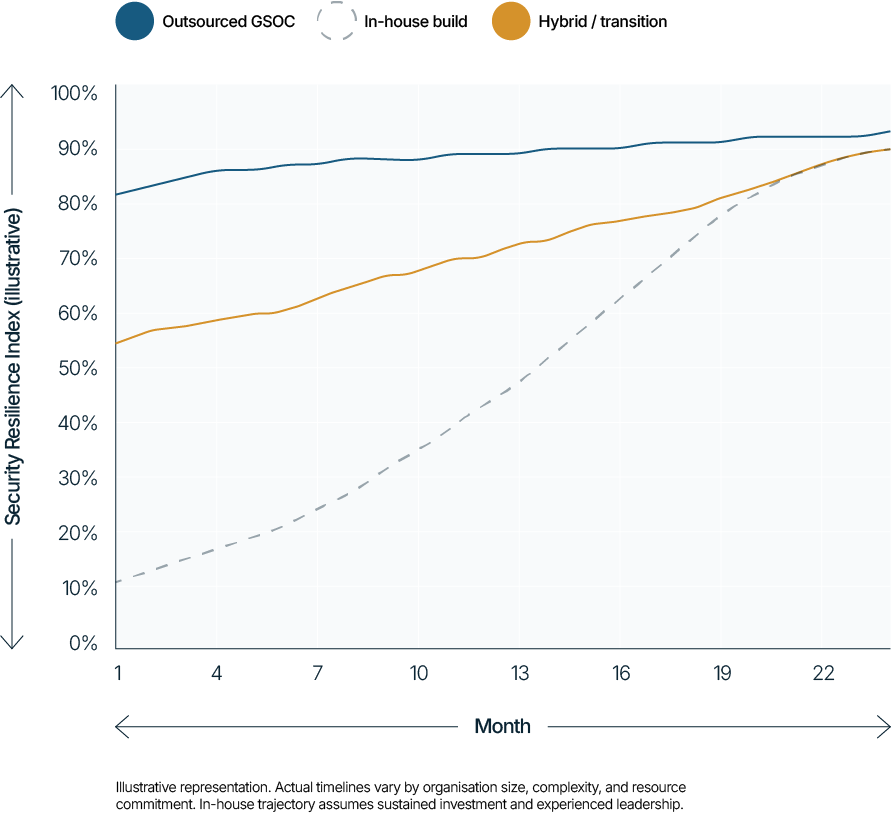
THE RESILIENCE CURVE
Outsourced vs In-House Capability Over Time
An illustrative comparison showing how organisational security resilience develops under each model.

How a global security operations centre connects your travel risk management programme
A GSOC does not replace strategic governance, specialist medical providers, or legal advisers. It provides the operational infrastructure that connects them, ensuring each element of your travel risk management programme functions as a coherent, always-on system rather than a set of independent arrangements.
Risk Intelligence and Threat Monitoring
Continuous active monitoring combining open-source, commercial, and human intelligence, generating alerts before incidents escalate. Analysts verify and contextualise intelligence against your specific travel population and destinations.
Travel Risk Management Platform
Real-time itinerary data, live location, automated check-in, SOS, and mass communication give analysts the visibility to monitor and escalate, while giving travellers the means to reach help instantly.
Journey Management and Enhanced Monitoring
For elevated and high-risk travel, the GSOC connects pre-travel planning, in-journey monitoring, and emergency response into one managed process, with scheduled check-ins and pre-agreed escalation protocols.
Emergency Response and ISO 31030 compliance
When situations escalate, the GSOC coordinates mobilisation across 191 countries. Automated incident recording and response logs create the audit trail ISO 31030 requires to demonstrate duty of care to leadership and insurers.
These measures support effective travel risk management and help organisations strengthen duty of care processes in line with ISO 31030 guidance.
How to Choose the Right GSOC Model for Your Organisation
The right model depends on your organisation’s travel volume, risk profile, existing security infrastructure, and urgency. There is no universal answer, the right model depends on the nuances of each organisation.
Outsourcing delivers immediate capability without the capital cost or build time of an in-house GSOC. Building in-house offers deeper organisational integration but takes 18–36 months to reach full capability. A hybrid of both is increasingly common for larger organisations managing the transition.
The table below compares both models across ten dimensions.
| Dimension | In-House GSOC | Outsourced GSOC |
|---|---|---|
| Time to operational capability | 12-24+ months Phased build; full capability after training, systems integration, and staffing | Days to weeks Immediate access to established infrastructure, trained analysts, and global partners |
| Upfront capital cost | High Facilities, technology stack, system integration, recruitment, and training | Low to moderate Typically subscription or usage-based; capex avoided |
| Ongoing operational cost | Variable Personnel costs dominant, difficult to scale down without impact on coverage | Predictable Contracted cost, scales with organisational need |
| Day 1 resilience | Partial Capability builds incrementally; risk exposure during ramp-up period | Full Immediate access to established protocols, live intelligence feeds, and trained response teams |
| Intelligence depth | Grows over time Organisation-specific context builds; broader geo-intelligence may lag initially | Immediate breadth Existing global HUMINT/OSINT networks, cross-client pattern recognition |
| Tailoring & Control | High Full control over processes, culture, and integration with internal systems | Moderate to high Configured to org protocols; some standardisation inherent in managed model |
| Scalability | Constrained Scaling requires additional headcount, training, and infrastructure investment | Flexible Provider absorbs demand spikes; surge capability available without lead time |
| ISO 31030 competence | Must be built Requires deliberate recruitment, training, and accreditation processes | Pre-existing Established competence frameworks, certifications, and specialist expertise |
| Business continuity | Requires planning Failover, redundancy, and contingency coverage must be independently designed | Built in Failover procedures and geographic redundancy typically embedded in provider model |
| Long-term strategic value | High if sustained Deep institutional knowledge, cultural alignment, competitive differentiator for large, complex organisations | High with right partner Provider relationship becomes a strategic asset; risks are dependency and transition costs |
GSOC-as-a-service FAQs
What is GSOC as a Service?
GSOC as a Service is a fully managed, outsourced security operations model that gives organisations 24/7 global threat monitoring, real-time traveller tracking, incident response, and intelligence analysis — without the capital cost or build time of an in-house GSOC. Providers deliver this through a subscription or retainer model, with full operational capability from day one and complete integration typically within three to four weeks.
What is the difference between a GSOC and a travel assistance company?
A travel assistance company responds reactively when an incident is reported — it provides a helpline for activated incidents, with no visibility of travellers unless a case is open. A GSOC provides continuous, proactive 24/7 monitoring whether or not an incident has been declared, with live traveller location data, pre-travel intelligence, automated check-in, SOS capability, and coordinated incident response. The GSOC monitors, detects, escalates, and coordinates proactively. The assistance company waits to be contacted.
What should we look for when evaluating a managed GSOC provider?
Due diligence on a managed GSOC provider should be structured across three tiers. Essential criteria, includes 24/7 analyst coverage with no gaps, a demonstrable global intelligence network, documented and tested incident response procedures, and ISO 27001 accreditation or equivalent for data handling. Important criteria includes integration capability with your existing travel management and HR systems, clear onboarding timelines with defined milestones, and named account management with escalation paths. Desirable criteria include experience in your specific operating regions or sectors, references from organisations of comparable size and risk profile, and the ability to support a hybrid model if you intend to develop internal capability in parallel. The full due diligence framework, tiered by Essential, Important, and Desirable, is included in the whitepaper.
What is the difference between an outsourced GSOC and a managed security operations centre (MSOC)?
The terms are sometimes used interchangeably, but in the context of travel risk and corporate security they describe different scopes. A managed security operations centre (MSOC) typically refers to outsourced cybersecurity monitoring — network traffic analysis, threat detection, and SIEM management. An outsourced GSOC in the travel risk context is concerned with physical security: monitoring the safety of people on the move, tracking travellers in real time, providing intelligence on destination risk, and coordinating emergency response. Some providers now offer integrated models that combine physical and cyber monitoring, but if you are evaluating suppliers for duty of care and ISO 31030 compliance purposes, confirming that the provider’s GSOC covers physical and people risk, not just digital threats, is an important early question.
What does ISO 31030 require of a travel risk management programme?
ISO 31030:2021 requires organisations to demonstrate that travel decisions are based on their capacity to treat risk. Top management must take and demonstrate ownership of the organisation’s travel risks. The standard covers four stages: scoping and risk criteria, the travel risk management process, journey and operational management, and recording and reporting. Key requirements include 24/7 traveller communication and emergency access, proactive risk identification, documented and exercised incident response procedures, lawful processing of traveller personal data, and a complete audit trail. Mental health is explicitly within scope under ISO 31030 7.4.9.
How quickly can GSOC-as-a-Service be operational?
With an outsourced GSOC, core monitoring and response capability is live from contract. Full operational integration — platform configuration to your protocols, traveller data feeds, HR system integration, and analyst briefing on your specific risk environment — typically takes three to four weeks. This compares to 12–18 months for an organisation with an existing security function but no dedicated monitoring, and 24–36 months for an organisation building a GSOC from a standing start.
Should we build a GSOC in-house or outsource it?
The right model depends on your travel volume, risk profile, available talent, budget structure, and urgency. Building in-house delivers deep organisational integration but takes 18–36 months and requires significant capital investment. Outsourcing delivers immediate capability with lower upfront cost and proven resilience. A hybrid model through using an outsourced GSOC from day one while developing internal capability in parallel is increasingly common. Solace Global’s whitepaper provides an impartial framework for making this decision, aligned to ISO 31030:2021.
What is Solace Secure and how does it support ISO 31030 compliance?
Solace Secure is Solace Global’s ISO 27001-accredited travel security platform, providing real-time alerts, itinerary tracking, live location monitoring, SOS capability, geofencing, and two-way mass communication. It integrates with leading travel management platforms and underpins the GSOC as a Service model. For ISO 31030 compliance, Solace Secure provides the automated recordkeeping, incident logging, programme metrics, and audit trail required by ISO 31030 10 — supporting organisations in demonstrating duty of care to leadership, auditors, and insurers.

Download the whitepaper
Download the whitepaper for the full framework, or speak to a Solace Global specialist about your current travel risk programme and where GSOC as a Service fits.