Evacuations from High-Risk Locations Call +44 (0)1202 308810 or Contact Us →

See a clearer view of your people, places, and risks around them.
One solution to combine verified intelligence, a 24/7 GSOC and on-the-ground teams to keep your people safe wherever they travel, live or work.

✓ 24/7 Security Assistance
✓ ISO27001 Accredited
✓ Human Alert Verification
✓ Global Partner Network
✓ Crisis Response Team
✓ 96% Would Recommend
THE PLATFORM
One platform, one team, and one coordinated response
TRAVEL RISK MANAGEMENT SOFTWARE
Built by Humans, For Humans

Technology
Verified intelligence, people and facility visibility, and communication tools in one connected platform.

Intelligence
Alerts are verified, risk-rated, categorised and geo-located by analysts before publication, supported by country reports and pre-travel advisoriess.

Security Response
The 24/7 GSOC monitors, coordinates and escalates response with our global partner network in alignment with your agreed SOPs.
Configured around your risk profile, protocols, and people

Account Management
Technical Support
Platform Configuration
Integration Support
Guided Onboarding
Admin Training
FEATURES & BENEFITS
See risk alerts more clearly, with immediate context around potential impact
MEET YOUR DUTY OF CARE
Understand who and what may be affected from one connected view
✓ See who’s affected in two clicks
✓ Every alert verified and risk-rated by an analyst
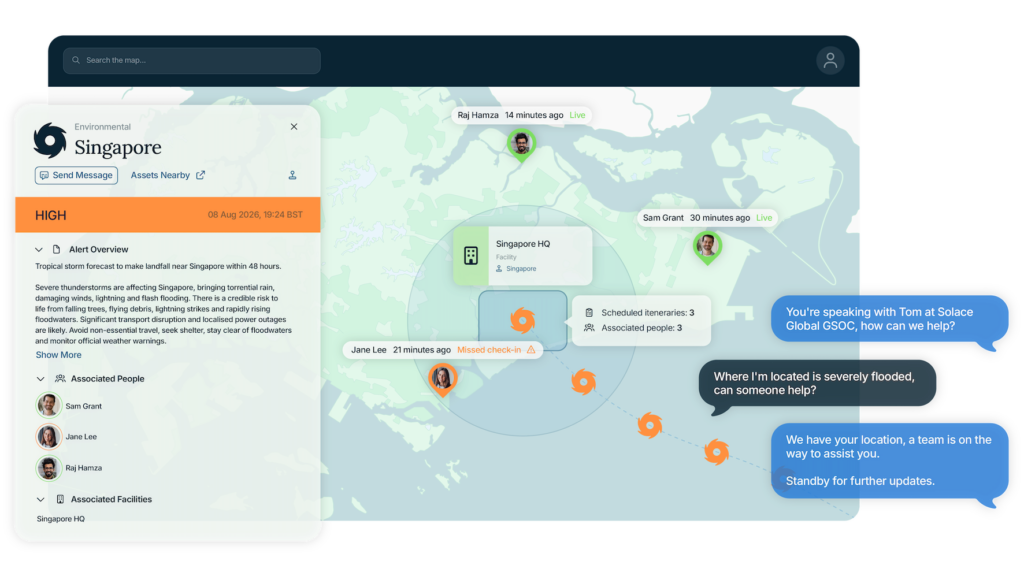
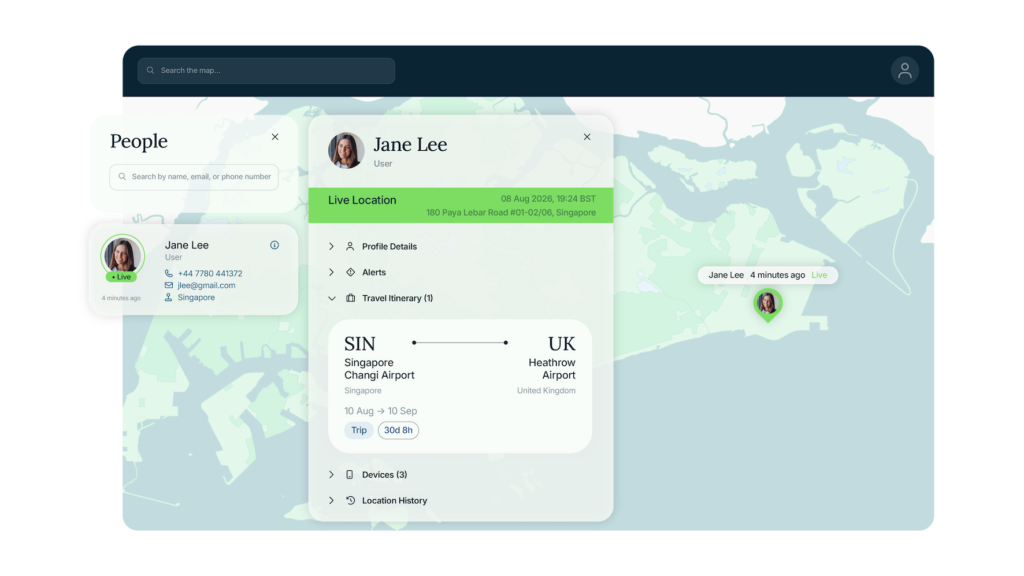
SEE WHO’S AFFECTED IN TWO CLICKS
Find people, see their movements and begin outreach from one place
✓ Up to 48 hours of location history
✓ Message directly from the panel
Ready to see it for yourself?
FAQs
Yes. The platform provides a live map view where authorised administrators can see the location and status of active travellers in one place, alongside their itineraries and any risk alerts affecting their area. Location sharing is permission-based, so travellers understand when and how their position is visible.
Yes. Your administrators and the Security Operations Centre can send updates and check in with travellers from the platform, using individual SMS and email or mass messaging to groups.
When an incident is detected, alerts are routed to your nominated contacts and to the Solace Global Security Operations Centre, which operates 24/7. Notification workflows can be configured to match your escalation structure, so the right people are informed based on the type of incident, its severity and the traveller’s location.
The SOS is designed to reduce accidental activations and to keep the traveller informed when it is triggered. On activation the app provides on screen confirmation and device feedback so the traveller knows an alert has started, with an option to cancel before it escalates. If the alert does reach the operations centre, an operator attempts to verify the situation with the traveller before escalating a response, which helps identify activations that were not intended.
The app is built to keep core protection available when connectivity drops. Location updates and alerts are queued and sync once a connection returns, and background operation allows tracking to continue when the app is not open, subject to the traveller’s device permissions. In areas with no mobile coverage, a satellite enabled device can maintain a communication link.
Location tracking is designed to be efficient, using intelligent update intervals rather than continuous high frequency GPS, so day to day impact on battery is kept modest. Actual usage varies by device, settings and how often the traveller is moving.
Itineraries can update automatically where a travel feed or booking integration is connected, and they can also be edited manually by an administrator or the traveller.
The GSOC can be contacted 24/7 to arrange journey management
In locations with limited or no mobile signal, a satellite communication device is the more reliable option for tracking and two way contact, and Solace Global can advise on suitable devices for the destination. This keeps a communication link open where the app alone would depend on mobile coverage.
Yes. The platform records a timeline of an incident, including notifications sent, traveller responses and actions taken by your team and the operations centre. This gives you a clear, exportable record for internal review and for demonstrating your response after the event.
The reporting module covers traveller activity, alerts, incidents and response actions, and you can build your own reports for specific needs. This supports duty of care obligations and internal governance reviews, and helps evidence how your organisation prepares for and responds to travel risk, aligned with recognised guidance such as ISO 31030 for travel risk management.
If a traveller needs medical help in a remote location, the operations centre coordinates access to appropriate medical care and, where required, arranges a medical evacuation to the nearest suitable facility. Where it is clinically appropriate, this can extend to repatriation to the traveller’s home country. Decisions are guided by medical advice, the traveller’s condition and the standard of care available locally, so the response fits the situation rather than following a fixed rule.
Solace Global coordinates the response and logistics of a medical evacuation as part of the service. The funding of medical treatment and evacuation costs is usually handled through the traveller’s insurance or your organisation’s cover, so it is worth confirming how coordination and cost cover fit together for your programme. Your account team can map this against your specific arrangement.
The Solace Global Security Operations Centre leads and coordinates the evacuation, working with local providers, medical teams and transport partners, and staying in contact with your nominated representatives throughout. Your organisation is kept informed and involved in key decisions rather than managing the logistics directly.
Yes. The operations centre remains engaged throughout an incident and continues to coordinate until the traveller reaches their destination or an appropriate medical facility and the situation is resolved. You receive updates through to the conclusion of the response.